Ch.12 - Solids and Solid-State Materials
McMurry - Chemistry 8th Edition
McMurry8th EditionChemistryISBN: 9781292336145당신이 사용하는 게 아니라요?교과서 변경
12장, 문제 51

Cesium chloride crystallizes in a cubic unit cell with Cl- ions at the corners and a Cs+ ion in the center. Count the numbers of + and - charges, and show that the unit cell is electrically neutral.

검증된 단계별 안내
1
Identify the positions of the ions in the unit cell: Cl- ions are located at each of the eight corners of the cube, and a single Cs+ ion is located at the center of the cube.
Calculate the contribution of Cl- ions to the unit cell. Since each corner ion is shared by eight adjacent unit cells, each Cl- ion contributes 1/8 of its charge to the unit cell. Multiply the charge contribution of one Cl- ion by the number of corners to find the total charge contributed by Cl- ions.
Consider the contribution of the Cs+ ion. Since the Cs+ ion is located at the center and not shared with any other unit cell, it contributes its entire charge to the unit cell.
Add up the total charges contributed by Cl- ions and the Cs+ ion. Remember that Cl- has a charge of -1 and Cs+ has a charge of +1.
Verify that the sum of the charges equals zero, demonstrating that the unit cell is electrically neutral.

비슷한 문제에 대한 검증된 영상 답변:

이 영상 해법은 위 문제에 도움이 된다고 튜터들이 추천한 것입니다.
영상 길이:
2m
도움이 되었나요?

주요 개념

질문에 올바르게 답하기 위해 반드시 이해해야 하는 핵심 개념들은 다음과 같습니다.

Ionic Compounds and Charges

Ionic compounds are formed from the electrostatic attraction between positively charged cations and negatively charged anions. In the case of cesium chloride (CsCl), cesium (Cs+) is the cation with a +1 charge, while chloride (Cl-) is the anion with a -1 charge. Understanding the charges of these ions is essential for determining the overall charge balance in the unit cell.
추천 영상:
가이드 코스
02:11
Ionic Compounds Naming

Unit Cell Structure

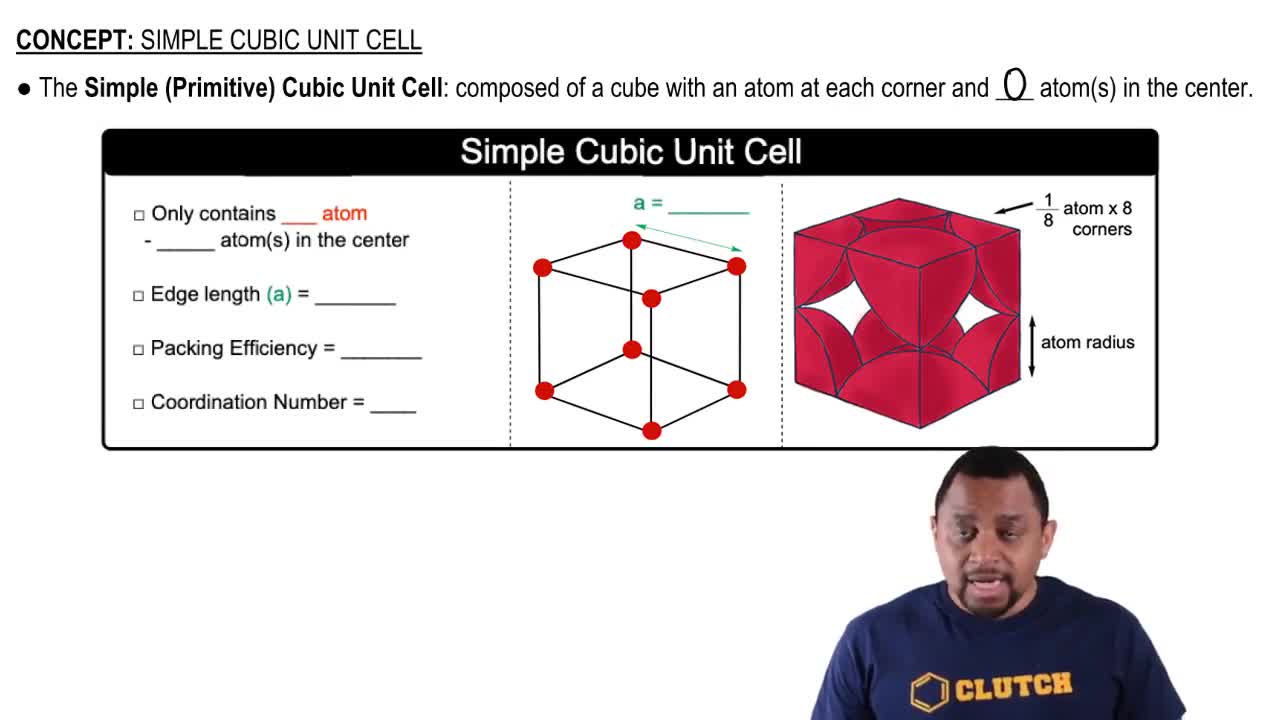
A unit cell is the smallest repeating unit in a crystal lattice that reflects the symmetry and structure of the entire crystal. In the cubic unit cell of cesium chloride, Cl- ions occupy the corners, and a Cs+ ion is located at the center. Recognizing the arrangement of ions within the unit cell is crucial for analyzing the charge distribution and confirming electrical neutrality.
추천 영상:
가이드 코스
01:27
Simple Cubic Unit Cell

Electrical Neutrality in Crystals

For a crystal to be electrically neutral, the total positive charge must equal the total negative charge. In the CsCl unit cell, there are eight Cl- ions at the corners, each contributing a -1 charge, and one Cs+ ion in the center contributing a +1 charge. By calculating the total charges, one can demonstrate that the unit cell maintains electrical neutrality, as the total charge sums to zero.
추천 영상:
가이드 코스
05:56
Lewis Dot Structures: Neutral Compounds
관련 실천
교과서 질문
Silicon carbide, SiC, is a covalent network solid with a structure similar to that of diamond. Sketch a small portion of the SiC structure.
1824
views
교과서 질문
If the edge length of an NaH unit cell is 488 pm, what is the length in picometers of an Na¬H bond? (See Problem 12.50.)
421
views
교과서 질문
If a protein can be induced to crystallize, its molecular structure can be determined by X-ray crystallography. Protein crystals, though solid, contain a large amount of water molecules along with the protein. The protein chicken egg-white lysozyme, for instance, crystallizes with a unit cell having angles of 90° and with edge lengths of 7.9 * 103 pm, 7.9 * 103 pm, and 3.8 * 103 pm. There are eight molecules in the unit cell. If the lysozyme molecule has a molecular weight of 1.44 * 104 and a density of 1.35 g>cm3, what percent of the unit cell is occupied by the protein?
557
views
교과서 질문
Carbon and oxygen combine to form the molecular compound CO2, while silicon and oxygen combine to form a covalent network solid with the formula unit SiO2. Explain the difference in bonding between the two group 4A elements and oxygen.
2164
views
교과서 질문
Sodium hydride, NaH, crystallizes in a face-centered cubic unit cell similar to that of NaCl (Figure 12.11). How many Na+ ions touch each H- ion, and how many H- ions touch each Na+ ion?
773
views
교과서 질문
Iron crystallizes in a body-centered cubic unit cell with an edge length of 287 pm. Iron metal has a density of 7.86 g>cm3 and a molar mass of 55.85 g. Calculate a value for Avogadro's number.
1973
views