Draw an MO energy-level diagram that shows the population
of the 4s band for potassium metal.
검증된 단계별 안내
1
Identify the electron configuration of a single potassium atom. Potassium has an atomic number of 19, which means it has 19 electrons. The electron configuration for potassium is 1s² 2s² 2p⁶ 3s² 3p⁶ 4s¹.
Understand the concept of molecular orbitals (MOs) in metals. In metals like potassium, atoms are arranged in a lattice and their outermost electrons (valence electrons) are delocalized. These delocalized electrons occupy molecular orbitals, which are spread over the entire metal crystal.
Recognize that in the MO diagram for potassium, the 4s orbital of each potassium atom combines with the 4s orbitals of other potassium atoms to form bonding and antibonding molecular orbitals. These are often referred to as bands in the context of metals.
Draw the MO diagram with the 4s band. Place the energy levels: the lower energy band (bonding) and the higher energy band (antibonding). The 4s band is partially filled as each potassium atom contributes one electron to the band.
Indicate the population of the 4s band on the diagram. Since each potassium atom contributes one electron, and potassium is in a metallic lattice, the 4s band will not be fully occupied, reflecting the metallic character and electrical conductivity of potassium.
비슷한 문제에 대한 검증된 영상 답변:
이 영상 해법은 위 문제에 도움이 된다고 튜터들이 추천한 것입니다.
영상 길이:
1m
영상 재생:
0 댓글
도움이 되었나요?
주요 개념
질문에 올바르게 답하기 위해 반드시 이해해야 하는 핵심 개념들은 다음과 같습니다.
Molecular Orbital Theory
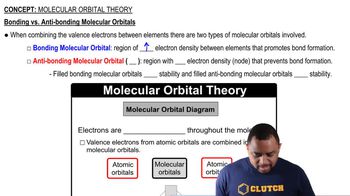
Molecular Orbital (MO) Theory describes the behavior of electrons in molecules, where atomic orbitals combine to form molecular orbitals that can be occupied by electrons. This theory helps explain the bonding and properties of molecules, including the energy levels of electrons. In the context of potassium metal, understanding how the 4s orbital is populated is crucial for visualizing its electronic structure.
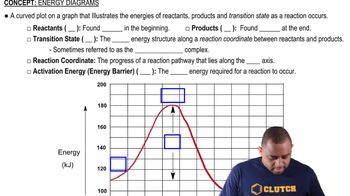
Energy level diagrams are graphical representations that illustrate the relative energy levels of atomic or molecular orbitals. These diagrams help visualize how electrons fill these orbitals according to the Aufbau principle, Hund's rule, and the Pauli exclusion principle. For potassium, the diagram will show the 4s orbital and its energy relative to other orbitals, indicating how many electrons occupy it.
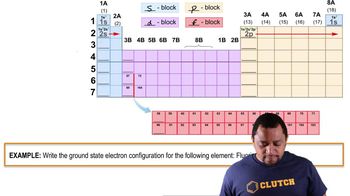
Electron configuration refers to the distribution of electrons among the various orbitals of an atom. For potassium (K), which has an atomic number of 19, the electron configuration is [Ar] 4s¹, indicating that there is one electron in the 4s orbital. This configuration is essential for understanding the chemical properties of potassium and how it interacts with other elements.