
Ch.12 - Solids and Solid-State Materials
McMurry - Chemistry 8th Edition
McMurry8th EditionChemistryISBN: 9781292336145당신이 사용하는 게 아니라요?교과서 변경
12장, 문제 75

Explain why the enthalpy of vaporization of vanadium (460 kJ/mol) is much larger than that of zinc (114 kJ/mol).

검증된 단계별 안내
1
Understand the concept of enthalpy of vaporization, which is the amount of energy required to convert one mole of a substance from the liquid phase to the vapor phase at constant temperature and pressure.
Recognize that vanadium and zinc are both transition metals, but they differ in their electronic configurations and bonding characteristics.
Consider the metallic bonding in vanadium and zinc. Vanadium, with a partially filled d-orbital, can form stronger metallic bonds due to the availability of more electrons for bonding compared to zinc, which has a completely filled d-orbital.
Acknowledge that stronger metallic bonds in vanadium result in a higher enthalpy of vaporization because more energy is required to overcome these bonds during the phase transition from liquid to gas.
Compare the atomic structures and bonding, noting that the stronger the bonding interactions within the metal, the higher the enthalpy of vaporization. This explains why vanadium, with its stronger metallic bonding, has a significantly higher enthalpy of vaporization than zinc.

비슷한 문제에 대한 검증된 영상 답변:

이 영상 해법은 위 문제에 도움이 된다고 튜터들이 추천한 것입니다.
영상 길이:
4m
도움이 되었나요?

주요 개념

질문에 올바르게 답하기 위해 반드시 이해해야 하는 핵심 개념들은 다음과 같습니다.

Enthalpy of Vaporization

Enthalpy of vaporization is the amount of energy required to convert a substance from a liquid to a gas at constant temperature and pressure. It reflects the strength of intermolecular forces within the liquid; stronger forces require more energy to overcome. This property is crucial for understanding why different substances have varying vaporization energies.
추천 영상:
가이드 코스
01:37
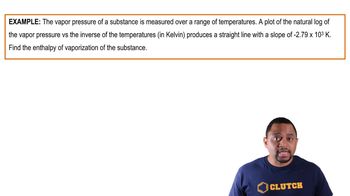
Enthalpy of Vaporization Example

Intermolecular Forces

Intermolecular forces are the attractive forces between molecules that influence physical properties such as boiling and melting points. In metals like vanadium, metallic bonding results in strong interactions between atoms, leading to a higher enthalpy of vaporization compared to zinc, which has weaker metallic bonds and thus lower energy requirements for vaporization.
추천 영상:
가이드 코스
01:59
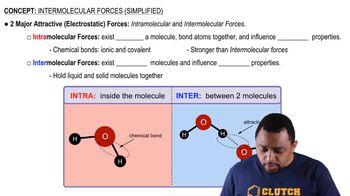
Intermolecular vs Intramolecular Forces

Atomic Structure and Bonding

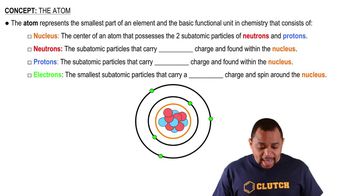
The atomic structure and bonding of an element determine its physical and chemical properties. Vanadium, being a transition metal with a more complex electron configuration, exhibits stronger bonding characteristics compared to zinc. This difference in bonding strength contributes to the significant disparity in their enthalpy of vaporization values.
추천 영상: