
Ch.12 - Solids and Solid-State Materials
McMurry - Chemistry 8th Edition
McMurry8th EditionChemistryISBN: 9781292336145당신이 사용하는 게 아니라요?교과서 변경
12장, 문제 142

The alkali metal fulleride superconductors M3C60 have a cubic closest-packed (face-centered cubic) arrangement of nearly spherical C60 3- anions with M+ cations in the holes between the larger C603- ions. The holes are of two types: octahedral holes, which are surrounded octahedrally by six C603- ions; and tetrahedral holes, which are surrounded tetrahedrally by four C603- ions. (c) Specify fractional coordinates for all the octahedral and tetrahedral holes. (Fractional coordinates are fractions of the unit cell edge lengths. For example, a hole at the center of the cell has fractional coordinates 12, 12, 12.)Diagram of a face-centered cubic unit cell showing Zn and F ions in a cubic arrangement.

검증된 단계별 안내
1
Identify the positions of the octahedral holes in the face-centered cubic (FCC) unit cell. These holes are located at the center of the unit cell and at the center of each edge.
Determine the fractional coordinates for the octahedral holes. The center of the unit cell has coordinates (1/2, 1/2, 1/2), and the centers of the edges have coordinates (1/2, 0, 0), (0, 1/2, 0), (0, 0, 1/2), (1/2, 1/2, 0), (1/2, 0, 1/2), and (0, 1/2, 1/2).
Identify the positions of the tetrahedral holes in the FCC unit cell. These holes are located at one-quarter and three-quarters along the body diagonals of the unit cell.
Determine the fractional coordinates for the tetrahedral holes. These coordinates are (1/4, 1/4, 1/4), (3/4, 3/4, 3/4), (1/4, 3/4, 3/4), (3/4, 1/4, 1/4), (1/4, 1/4, 3/4), (3/4, 3/4, 1/4), (1/4, 3/4, 1/4), and (3/4, 1/4, 3/4).
Summarize the fractional coordinates for both octahedral and tetrahedral holes in the FCC unit cell.

비슷한 문제에 대한 검증된 영상 답변:

이 영상 해법은 위 문제에 도움이 된다고 튜터들이 추천한 것입니다.
영상 길이:
2m
도움이 되었나요?

주요 개념

질문에 올바르게 답하기 위해 반드시 이해해야 하는 핵심 개념들은 다음과 같습니다.

Cubic Closest-Packed Structure

The cubic closest-packed (CCP) structure, also known as face-centered cubic (FCC), is a type of crystal lattice where atoms are packed together as closely as possible. In this arrangement, each unit cell contains atoms at each corner and the centers of all the faces, maximizing the packing efficiency. This structure is significant in understanding how ions like M+ and C60 3- are arranged in the alkali metal fulleride superconductors.
추천 영상:
가이드 코스
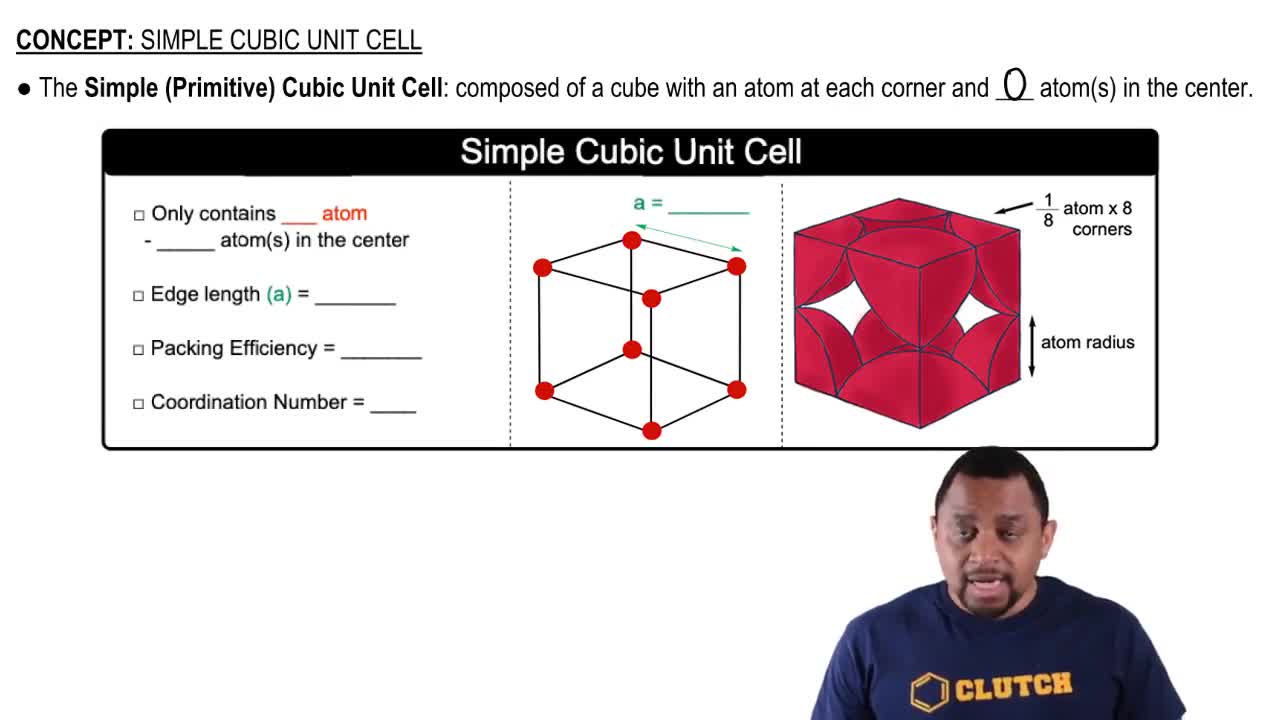
01:27
Simple Cubic Unit Cell

Fractional Coordinates

Fractional coordinates are a way to express the position of atoms or holes within a unit cell in a crystal lattice. They are given as fractions of the unit cell dimensions, allowing for a standardized method to describe positions regardless of the actual size of the unit cell. For example, a hole located at the center of the unit cell would have fractional coordinates of (1/2, 1/2, 1/2), which is essential for identifying the locations of octahedral and tetrahedral holes in the structure.
추천 영상:
가이드 코스
00:27
Coordination Numbers

Octahedral and Tetrahedral Holes

In a crystal lattice, octahedral and tetrahedral holes refer to the voids or spaces between atoms where additional ions can fit. Octahedral holes are surrounded by six atoms, forming an octahedron, while tetrahedral holes are surrounded by four atoms, forming a tetrahedron. Understanding the positions and types of these holes is crucial for determining how cations like M+ can occupy these spaces in the fulleride structure, influencing the material's properties.
추천 영상:
가이드 코스
01:38
The crystal field splitting pattern for tetrahedral complexes has the d orbitals in between the axes as having the higher energy.
관련 실천
교과서 질문

Small molecules with C'C double bonds, called monomers, can join with one another to form long chain molecules called polymers. Thus, acrylonitrile, H2C'CHCN, polymerizes under appropriate conditions to give polyacrylonitrile, a common starting material for producing the carbon fibers used in composites. (b) Use the bond dissociation energies in Table 7.1 to calculate ΔH per H2C'CHCN unit for the conversion of acrylonitrile to polyacrylonitrile. Is the reaction endothermic or exothermic?

542
views
교과서 질문

The mineral wustite is a nonstoichiometric iron oxide with the empirical formula FexO, where x is a number slightly less than 1. Wustite can be regarded as an FeO in which some of the Fe sites are vacant. It has a density of 5.75 g>cm3, a cubic unit cell with an edge length of 431 pm, and a facecentered cubic arrangement of oxygen atoms. (c) Each Fe atom in wustite is in either the +2 or the +3 oxidation state. What percent of the Fe atoms are in the +3 oxidation state?

771
views
교과서 질문

Small molecules with C=C double bonds, called monomers, can join with one another to form long chain molecules called polymers. Thus, acrylonitrile, H2C=CHCN, polymerizes under appropriate conditions to give polyacrylonitrile, a common starting material for producing the carbon fibers used in composites. (a) Write electron-dot structures for acrylonitrile and polyacrylonitrile, and show how rearranging the electrons can lead to formation of the polymer.

317
views
교과서 질문
Europium(II) oxide is a semiconductor with a band gap of 108 kJ/mol. Below 69 K, it is also ferromagnetic, meaning all the unpaired electrons on europium are aligned in the same direction. How many f electrons are present on each europium ion in EuO? (In lanthanide ions the 4f orbitals are lower in energy than the 6s orbitals.)
556
views
교과서 질문

The mineral wustite is a nonstoichiometric iron oxide with the empirical formula FexO, where x is a number slightly less than 1. Wustite can be regarded as an FeO in which some of the Fe sites are vacant. It has a density of 5.75 g>cm3, a cubic unit cell with an edge length of 431 pm, and a facecentered cubic arrangement of oxygen atoms. (d) Using X rays with a wavelength of 70.93 pm, at what angle would third-order diffraction be observed from the planes of atoms that coincide with the faces of the unit cells? Third-order diffraction means that the value of n in the Bragg equation is equal to 3.

293
views