Ch.12 - Solids and Solid-State Materials
McMurry - Chemistry 8th Edition
McMurry8th EditionChemistryISBN: 9781292336145당신이 사용하는 게 아니라요?교과서 변경
12장, 문제 45

The density of a sample of metal was measured to be 6.84 g>cm3. An X-ray diffraction experiment measures the edge of a face-centered cubic cell as 350.7 pm. What is the atomic weight, atomic radius, and identity of the metal?

검증된 단계별 안내
1
Calculate the volume of the cubic unit cell using the edge length provided. The volume (V) of a cube is given by the formula V = a^3, where 'a' is the edge length of the cube.
Convert the edge length from picometers (pm) to centimeters (cm) to match the units of the density given. Remember that 1 cm = 10^10 pm.
Calculate the mass of the unit cell using the density formula, Density = Mass/Volume. Rearrange the formula to find the mass (Mass = Density × Volume).
Determine the number of atoms per unit cell for a face-centered cubic (FCC) lattice. In an FCC lattice, there are 4 atoms per unit cell.
Calculate the atomic weight of the metal. The atomic weight can be found by dividing the mass of the unit cell by the number of atoms per unit cell. Finally, use the atomic weight to identify the metal by comparing it with known atomic weights of elements.

비슷한 문제에 대한 검증된 영상 답변:

이 영상 해법은 위 문제에 도움이 된다고 튜터들이 추천한 것입니다.
영상 길이:
4m

주요 개념

질문에 올바르게 답하기 위해 반드시 이해해야 하는 핵심 개념들은 다음과 같습니다.

Density and its Calculation

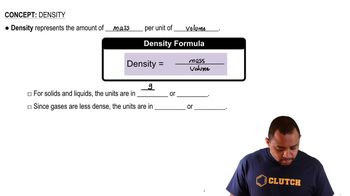
Density is defined as mass per unit volume, typically expressed in grams per cubic centimeter (g/cm³). In this context, the density of the metal sample is given as 6.84 g/cm³, which can be used alongside the volume of the unit cell to determine the mass of the metal atoms within that cell. Understanding how to relate density to atomic weight and volume is crucial for solving the problem.
추천 영상:
가이드 코스
01:56
Density Concepts

Face-Centered Cubic (FCC) Structure

A face-centered cubic (FCC) structure is a type of crystal lattice where atoms are located at each of the corners and the centers of all the faces of the cube. The edge length of the unit cell is critical for calculating the atomic radius, which can be derived from the relationship between the edge length and the atomic radius in an FCC lattice. This structure is common in metals and influences their properties.
추천 영상:
가이드 코스
00:51
Face Centered Cubic Example

X-ray Diffraction and Unit Cell Parameters

X-ray diffraction is a technique used to determine the atomic structure of a crystal by measuring the angles and intensities of scattered X-rays. The edge length of the unit cell, measured as 350.7 pm (picometers), is essential for calculating the volume of the unit cell and subsequently the number of atoms it contains. This information, combined with density, allows for the determination of atomic weight and the identity of the metal.
추천 영상:
가이드 코스
01:27
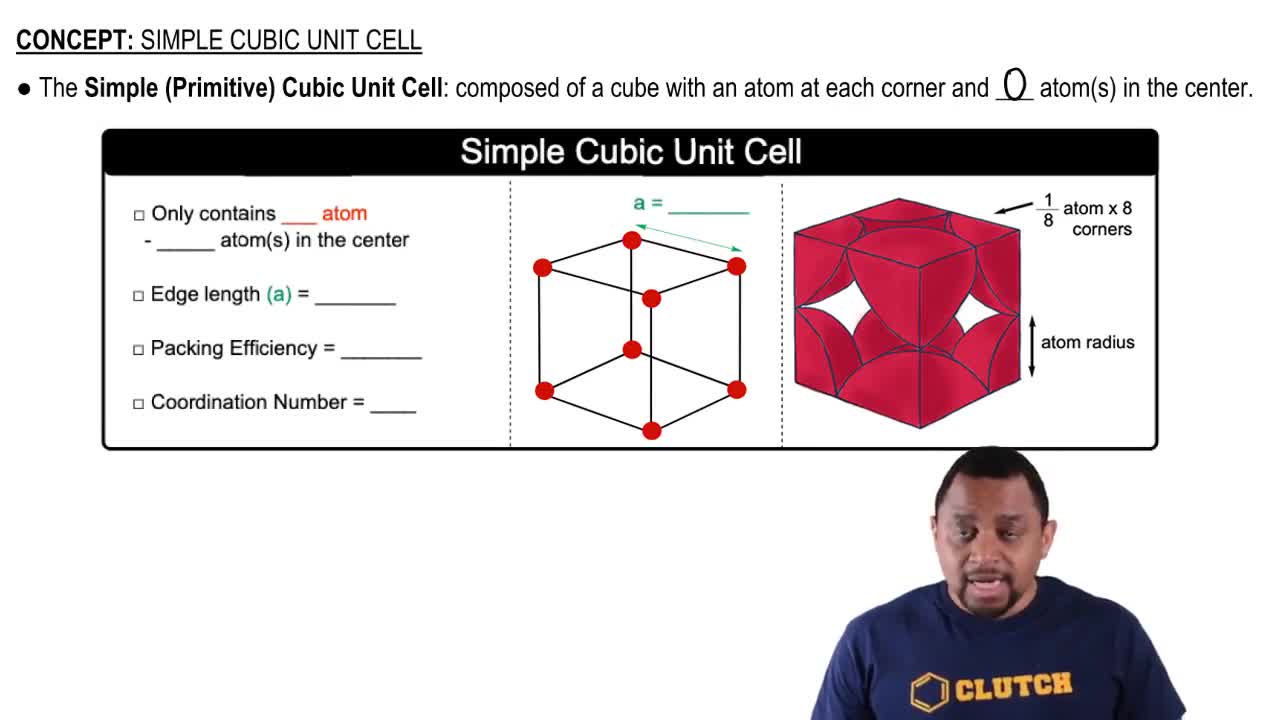
Simple Cubic Unit Cell
관련 실천
교과서 질문
The atomic radius of Pb is 175 pm, and the density is 11.34 g>cm3. Does lead have a primitive cubic structure or a face-centered cubic structure?
1405
views
교과서 질문
Sodium has a density of 0.971 g>cm3 and crystallizes with a body-centered cubic unit cell. What is the radius of a sodium atom, and what is the edge length of the cell in picometers?
2324
views
교과서 질문
If a protein can be induced to crystallize, its molecular structure can be determined by X-ray crystallography. Protein crystals, though solid, contain a large amount of water molecules along with the protein. The protein chicken egg-white lysozyme, for instance, crystallizes with a unit cell having angles of 90° and with edge lengths of 7.9 * 103 pm, 7.9 * 103 pm, and 3.8 * 103 pm. There are eight molecules in the unit cell. If the lysozyme molecule has a molecular weight of 1.44 * 104 and a density of 1.35 g>cm3, what percent of the unit cell is occupied by the protein?
557
views
교과서 질문
Sodium hydride, NaH, crystallizes in a face-centered cubic unit cell similar to that of NaCl (Figure 12.11). How many Na+ ions touch each H- ion, and how many H- ions touch each Na+ ion?
773
views
교과서 질문
Iron crystallizes in a body-centered cubic unit cell with an edge length of 287 pm. Iron metal has a density of 7.86 g>cm3 and a molar mass of 55.85 g. Calculate a value for Avogadro's number.
1973
views
교과서 질문
Titanium metal has a density of 4.506 g>cm3 and an atomic radius of 144.8 pm. In what cubic unit cell does titanium crystallize?
1145
views