Write a balanced equation for the synthesis of the 2–6 semiconductor ZnTe by chemical vapor deposition from dimethylzinc, Zn(CH3)2, and diethyltellurium, Te(CH2CH3)2, assuming that the other product is gaseous propane (CH3CH2CH3).
검증된 단계별 안내
1
Step 1: Write down the unbalanced chemical equation. The reactants are dimethylzinc (Zn(CH3)2) and diethyltellurium (Te(C2H5)2), and the products are ZnTe and propane (C3H8). So, the unbalanced equation is: Zn(CH3)2 + Te(C2H5)2 → ZnTe + C3H8
Step 2: Balance the equation for the metal atoms first. In this case, both sides of the equation have one zinc atom and one tellurium atom, so they are already balanced.
Step 3: Balance the equation for the carbon atoms. There are 2 carbon atoms in each molecule of dimethylzinc and 4 carbon atoms in each molecule of diethyltellurium on the reactant side, and 3 carbon atoms in each molecule of propane on the product side. To balance the carbon atoms, we need to have 2 molecules of propane on the product side. So, the equation becomes: Zn(CH3)2 + Te(C2H5)2 → ZnTe + 2C3H8
Step 4: Balance the equation for the hydrogen atoms. There are 6 hydrogen atoms in each molecule of dimethylzinc and 10 hydrogen atoms in each molecule of diethyltellurium on the reactant side, and 8 hydrogen atoms in each molecule of propane on the product side. To balance the hydrogen atoms, we need to have 2 molecules of dimethylzinc and 1 molecule of diethyltellurium on the reactant side. So, the equation becomes: 2Zn(CH3)2 + Te(C2H5)2 → 2ZnTe + 2C3H8
Step 5: Check the equation to make sure it is balanced. Each side of the equation should have the same number of each type of atom. In this case, both sides have 2 zinc atoms, 1 tellurium atom, 6 carbon atoms, and 16 hydrogen atoms, so the equation is balanced.
비슷한 문제에 대한 검증된 영상 답변:
이 영상 해법은 위 문제에 도움이 된다고 튜터들이 추천한 것입니다.
영상 길이:
1m
영상 재생:
0 댓글
주요 개념
질문에 올바르게 답하기 위해 반드시 이해해야 하는 핵심 개념들은 다음과 같습니다.
Chemical Vapor Deposition (CVD)
Chemical Vapor Deposition (CVD) is a process used to produce thin films and coatings on substrates. In CVD, gaseous reactants undergo chemical reactions on the substrate surface, leading to the deposition of solid material. This technique is widely used in semiconductor manufacturing, where precise control over film composition and thickness is crucial.
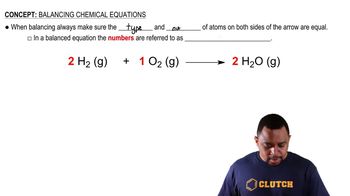
Balancing chemical equations is essential to ensure that the law of conservation of mass is upheld, meaning the number of atoms of each element must be the same on both sides of the equation. This involves adjusting coefficients in front of compounds to achieve equal numbers of each type of atom. A balanced equation provides a clear representation of the reactants and products involved in a chemical reaction.
Organometallic compounds are chemical compounds that contain at least one bond between a carbon atom of an organic molecule and a metal. In the context of the synthesis of ZnTe, dimethylzinc (Zn(CH₃)₂) and diethyltellurium (Te(CH₂CH₃)₂) are organometallic precursors that provide the zinc and tellurium needed for the semiconductor. Understanding their reactivity and behavior is crucial for predicting the products of the reaction.


 검증된 단계별 안내
 02:40
02:40