
Ch.13 - Solutions & Their Properties
McMurry - Chemistry 8th Edition
McMurry8th EditionChemistryISBN: 9781292336145당신이 사용하는 게 아니라요?교과서 변경
13장, 문제 52

Ethyl alcohol, CH3CH2OH, is miscible with water at 20 °C, but pentyl alcohol, CH3CH2CH2CH2CH2OH, is soluble in water only to the extent of 2.7 g/100 mL. Explain.

검증된 단계별 안내
1
Step 1: Understand the concept of miscibility and solubility. Miscibility refers to the ability of two liquids to mix in all proportions, forming a homogeneous solution. Solubility, on the other hand, refers to the maximum amount of a substance that can dissolve in a solvent at a given temperature.
Step 2: Analyze the molecular structure of ethyl alcohol (CH3CH2OH) and pentyl alcohol (CH3CH2CH2CH2CH2OH). Both contain a hydroxyl group (-OH) which is polar and can form hydrogen bonds with water, a polar solvent.
Step 3: Consider the impact of the hydrocarbon chain length on solubility. Ethyl alcohol has a shorter hydrocarbon chain (2 carbon atoms) compared to pentyl alcohol (5 carbon atoms). The longer the hydrocarbon chain, the more nonpolar the molecule becomes, reducing its ability to interact with water.
Step 4: Explain the role of hydrogen bonding. Ethyl alcohol can form strong hydrogen bonds with water due to its polar -OH group, making it fully miscible. In contrast, the longer nonpolar chain in pentyl alcohol limits its ability to form hydrogen bonds, reducing its solubility.
Step 5: Conclude by linking molecular structure to solubility behavior. The balance between the polar -OH group and the nonpolar hydrocarbon chain determines the solubility of alcohols in water. Ethyl alcohol's shorter chain allows it to be miscible, while pentyl alcohol's longer chain limits its solubility.

주요 개념

질문에 올바르게 답하기 위해 반드시 이해해야 하는 핵심 개념들은 다음과 같습니다.

Polarity and Hydrogen Bonding

Polarity refers to the distribution of electrical charge over the atoms in a molecule. Ethyl alcohol (CH3CH2OH) has a hydroxyl (-OH) group that is polar, allowing it to form hydrogen bonds with water molecules. This strong interaction enhances its miscibility with water. In contrast, pentyl alcohol (CH3CH2CH2CH2CH2OH) has a longer non-polar hydrocarbon chain, which reduces its overall polarity and hydrogen bonding capability with water.
추천 영상:
가이드 코스
02:38
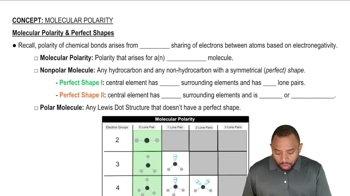
Molecular Polarity

Hydrophobic vs. Hydrophilic Interactions

Hydrophilic substances, like ethyl alcohol, interact favorably with water due to their polar nature, leading to high solubility. Conversely, hydrophobic substances, such as the long hydrocarbon chain in pentyl alcohol, do not interact well with water, resulting in limited solubility. The balance between hydrophilic and hydrophobic characteristics determines the extent to which a substance can dissolve in water.
추천 영상:
가이드 코스
03:05
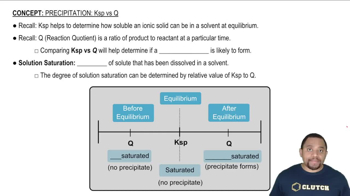
Ksp vs Q in Precipitation

Molecular Size and Solubility

The size of a molecule significantly impacts its solubility in water. Smaller molecules, like ethyl alcohol, can easily interact with water molecules, enhancing solubility. In contrast, larger molecules, such as pentyl alcohol, have increased hydrophobic character due to their extensive non-polar regions, which limits their solubility in water. This size effect is crucial in understanding the solubility differences between these two alcohols.
추천 영상:
가이드 코스
00:28
Solubility Rules