Ch.13 - Solutions & Their Properties
McMurry - Chemistry 8th Edition
McMurry8th EditionChemistryISBN: 9781292336145당신이 사용하는 게 아니라요?교과서 변경
13장, 문제 127

What is the reason behind the boiling point of a solution being 100.8 °C when 71 g of Na2SO4 is dissolved in 1.00 kg of water?

검증된 단계별 안내
1
Step 1: Understand the concept of boiling point elevation, which is a colligative property. It depends on the number of solute particles in a solution, not their identity.
Step 2: Calculate the molality of the solution. First, determine the molar mass of Na2SO4 by adding the atomic masses of its constituent elements: Na (22.99 g/mol), S (32.07 g/mol), and O (16.00 g/mol).
Step 3: Convert the mass of Na2SO4 (71 g) to moles using its molar mass. Then, calculate the molality by dividing the moles of Na2SO4 by the mass of the solvent (water) in kilograms.
Step 4: Determine the van't Hoff factor (i) for Na2SO4. Since it dissociates into 3 ions (2 Na+ and 1 SO4^2-), i = 3.
Step 5: Use the boiling point elevation formula: \( \Delta T_b = i \cdot K_b \cdot m \), where \( \Delta T_b \) is the boiling point elevation, \( K_b \) is the ebullioscopic constant for water (0.512 °C/m), and m is the molality. Calculate \( \Delta T_b \) and add it to the normal boiling point of water (100 °C) to find the new boiling point.

주요 개념

질문에 올바르게 답하기 위해 반드시 이해해야 하는 핵심 개념들은 다음과 같습니다.

Boiling Point Elevation

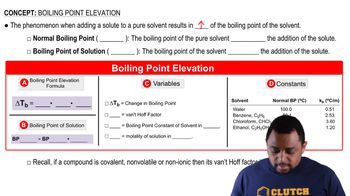
Boiling point elevation is a colligative property that describes how the boiling point of a solvent increases when a solute is dissolved in it. This phenomenon occurs because the presence of solute particles disrupts the formation of vapor above the liquid, requiring a higher temperature to reach the boiling point. The extent of boiling point elevation can be calculated using the formula ΔT_b = i * K_b * m, where 'i' is the van 't Hoff factor, 'K_b' is the ebullioscopic constant of the solvent, and 'm' is the molality of the solution.
추천 영상:
가이드 코스
03:05
Boiling Point Elevation

Van 't Hoff Factor (i)

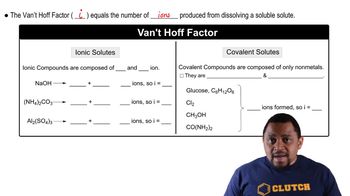
The van 't Hoff factor (i) indicates the number of particles into which a solute dissociates in solution. For ionic compounds like Na2SO4, which dissociates into three ions (2 Na+ and 1 SO4^2-), the van 't Hoff factor is 3. This factor is crucial for calculating colligative properties, as it directly influences the extent of boiling point elevation and other related phenomena.
추천 영상:
가이드 코스
02:50
Van't Hoff Factor

Molality

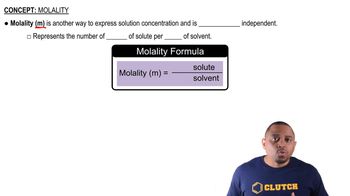
Molality is a measure of concentration defined as the number of moles of solute per kilogram of solvent. It is expressed in units of mol/kg and is particularly useful in colligative property calculations because it remains unaffected by temperature changes. In the context of the question, knowing the molality of the Na2SO4 solution allows for the determination of how much the boiling point of water is elevated due to the dissolved solute.
추천 영상: