
Ch.13 - Solutions & Their Properties
McMurry - Chemistry 8th Edition
McMurry8th EditionChemistryISBN: 9781292336145당신이 사용하는 게 아니라요?교과서 변경
13장, 문제 30

The following phase diagram shows part of the liquid–vapor phase-transition boundaries for pure ether and a solution of a nonvolatile solute in ether. Phase diagram showing vapor pressure vs temperature for pure ether and a solution.
(b) What is the approximate mo#lal concentration of the sol-ute? [Kb for ether is 2.021°C kg2>mol.]

검증된 단계별 안내
1
Identify the boiling points of pure ether and the solution from the phase diagram at the vapor pressure of 760 torr.
Calculate the boiling point elevation (ΔT_b) by subtracting the boiling point of pure ether from the boiling point of the solution.
Use the boiling point elevation formula ΔT_b = K_b * m, where K_b is the ebullioscopic constant (2.021°C kg/mol for ether) and m is the molal concentration of the solute.
Rearrange the formula to solve for the molal concentration (m): m = ΔT_b / K_b.
Substitute the values of ΔT_b and K_b into the equation to find the molal concentration of the solute.

비슷한 문제에 대한 검증된 영상 답변:

이 영상 해법은 위 문제에 도움이 된다고 튜터들이 추천한 것입니다.
영상 길이:
3m

주요 개념

질문에 올바르게 답하기 위해 반드시 이해해야 하는 핵심 개념들은 다음과 같습니다.

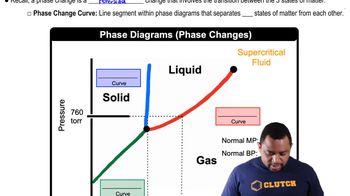
Phase Diagrams

A phase diagram is a graphical representation that shows the phases of a substance as a function of temperature and pressure. It illustrates the boundaries between different phases, such as solid, liquid, and gas, and indicates conditions under which these phases coexist. In this case, the phase diagram for ether and a solution helps visualize how the vapor pressure changes with temperature for both pure ether and a solution containing a nonvolatile solute.
추천 영상:
가이드 코스
03:22
Phase Changes in Diagrams

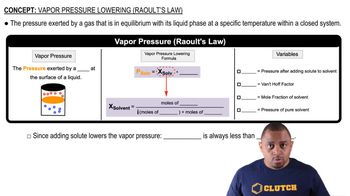
Raoult's Law

Raoult's Law states that the vapor pressure of a solvent in a solution is directly proportional to the mole fraction of the solvent present. This principle is crucial for understanding how the addition of a nonvolatile solute affects the vapor pressure of the solvent, leading to a decrease in vapor pressure compared to that of the pure solvent. This law is fundamental in calculating the molal concentration of the solute based on the observed changes in vapor pressure.
추천 영상:
가이드 코스
02:40
Raoult's Law and Vapor Pressure

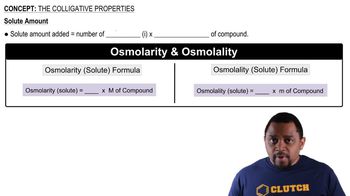
Colligative Properties

Colligative properties are properties of solutions that depend on the number of solute particles in a given amount of solvent, rather than the identity of the solute. These properties include vapor pressure lowering, boiling point elevation, freezing point depression, and osmotic pressure. In this question, the focus is on vapor pressure lowering, which is essential for determining the molal concentration of the solute in the ether solution.
추천 영상:
가이드 코스
01:26
Colligative Properties