
Ch.13 - Solutions & Their Properties
McMurry - Chemistry 8th Edition
McMurry8th EditionChemistryISBN: 9781292336145당신이 사용하는 게 아니라요?교과서 변경
13장, 문제 137

What is the value of the van’t Hoff factor for KCl if a 1.00 m aqueous solution shows a vapor pressure depression of 0.734 mm Hg at 298 K? (The vapor pressure of water at 298 K is 23.76 mm Hg.)

검증된 단계별 안내
1
Identify the formula for vapor pressure depression: \( \Delta P = i \cdot m \cdot K_f \), where \( \Delta P \) is the vapor pressure depression, \( i \) is the van’t Hoff factor, \( m \) is the molality, and \( K_f \) is the cryoscopic constant. However, since we are dealing with vapor pressure, we use \( \Delta P = i \cdot m \cdot P^0 \), where \( P^0 \) is the vapor pressure of the pure solvent.
Calculate the vapor pressure depression \( \Delta P \) using the given values: \( \Delta P = P^0 - P_{solution} = 23.76 \text{ mm Hg} - (23.76 \text{ mm Hg} - 0.734 \text{ mm Hg}) \).
Substitute the known values into the vapor pressure depression formula: \( 0.734 \text{ mm Hg} = i \cdot 1.00 \text{ m} \cdot 23.76 \text{ mm Hg} \).
Solve for the van’t Hoff factor \( i \) by rearranging the equation: \( i = \frac{0.734 \text{ mm Hg}}{1.00 \text{ m} \cdot 23.76 \text{ mm Hg}} \).
Interpret the result: The van’t Hoff factor \( i \) represents the number of particles the solute dissociates into in solution. For KCl, which dissociates into K\(^+\) and Cl\(^-\), the theoretical value of \( i \) should be close to 2.

주요 개념

질문에 올바르게 답하기 위해 반드시 이해해야 하는 핵심 개념들은 다음과 같습니다.

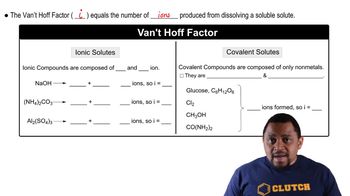
van't Hoff Factor (i)

The van't Hoff factor (i) is a measure of the number of particles into which a solute dissociates in solution. For ionic compounds like KCl, which dissociates into K+ and Cl- ions, the van't Hoff factor is typically 2. This factor is crucial for calculating colligative properties, such as vapor pressure depression, as it directly influences the extent of these properties based on the number of solute particles present.
추천 영상:
가이드 코스
02:50
Van't Hoff Factor

Vapor Pressure Depression

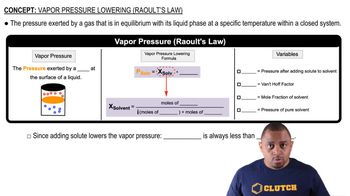
Vapor pressure depression occurs when a non-volatile solute is added to a solvent, resulting in a decrease in the solvent's vapor pressure. This phenomenon is a colligative property, meaning it depends on the number of solute particles rather than their identity. The extent of vapor pressure depression can be calculated using Raoult's Law, which relates the vapor pressure of the solution to the mole fraction of the solvent.
추천 영상:
가이드 코스
02:40
Raoult's Law and Vapor Pressure

Raoult's Law

Raoult's Law states that the vapor pressure of a solvent in a solution is equal to the vapor pressure of the pure solvent multiplied by its mole fraction in the solution. This law is fundamental in understanding how the addition of solute affects the vapor pressure of the solvent. In the context of the question, it allows for the calculation of the van't Hoff factor by relating the observed vapor pressure depression to the concentration of the solute.
추천 영상:
가이드 코스
02:40
Raoult's Law and Vapor Pressure