Ch.13 - Solutions & Their Properties
McMurry - Chemistry 8th Edition
McMurry8th EditionChemistryISBN: 9781292336145당신이 사용하는 게 아니라요?교과서 변경
13장, 문제 102

What is the vapor pressure in mm Hg of the following solu-tions, each of which contains a nonvolatile solute? The vapor pressure of water at 45.0 °C is 71.93 mm Hg. (b) A solution of 10.0 g of LiCl in 150.0 g of water at 45.0 °C, assuming complete dissociation

검증된 단계별 안내
1
Calculate the moles of LiCl using its molar mass.
Determine the moles of water using its molar mass.
Assuming complete dissociation, calculate the total moles of ions produced by LiCl.
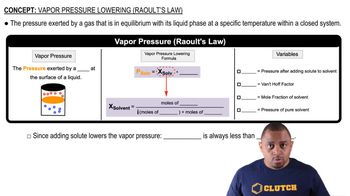
Use Raoult's Law to find the vapor pressure of the solution: \( P_{solution} = \chi_{solvent} \times P^0_{solvent} \), where \( \chi_{solvent} \) is the mole fraction of the solvent.
Calculate the mole fraction of water (solvent) by dividing the moles of water by the total moles of particles in the solution (moles of water + moles of ions from LiCl).

비슷한 문제에 대한 검증된 영상 답변:

이 영상 해법은 위 문제에 도움이 된다고 튜터들이 추천한 것입니다.
영상 길이:
5m

주요 개념

질문에 올바르게 답하기 위해 반드시 이해해야 하는 핵심 개념들은 다음과 같습니다.

Vapor Pressure

Vapor pressure is the pressure exerted by a vapor in equilibrium with its liquid or solid phase at a given temperature. It reflects the tendency of particles to escape from the liquid phase into the vapor phase. In solutions, the presence of a solute lowers the vapor pressure compared to that of the pure solvent, a phenomenon described by Raoult's Law.
추천 영상:
가이드 코스
02:40
Raoult's Law and Vapor Pressure

Raoult's Law

Raoult's Law states that the vapor pressure of a solvent in a solution is directly proportional to the mole fraction of the solvent. For a solution containing a nonvolatile solute, the vapor pressure can be calculated by multiplying the vapor pressure of the pure solvent by the mole fraction of the solvent in the solution. This law is essential for understanding how solutes affect the vapor pressure of solvents.
추천 영상:
가이드 코스
02:40
Raoult's Law and Vapor Pressure

Colligative Properties

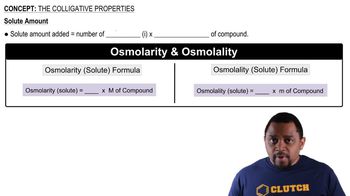
Colligative properties are properties of solutions that depend on the number of solute particles in a given amount of solvent, rather than the identity of the solute. These properties include vapor pressure lowering, boiling point elevation, freezing point depression, and osmotic pressure. Understanding colligative properties is crucial for calculating changes in vapor pressure when a nonvolatile solute is added to a solvent.
추천 영상:
가이드 코스
01:26
Colligative Properties