
Ch.13 - Solutions & Their Properties
McMurry - Chemistry 8th Edition
McMurry8th EditionChemistryISBN: 9781292336145당신이 사용하는 게 아니라요?교과서 변경
13장, 문제 91

Which of the following aqueous solutions has the (a) higher freezing point, (b) higher boiling point, (c) lower vapor pressure: 0.50 m sucrose (C12H22O11) or 0.35 m HNO3?

검증된 단계별 안내
1
Step 1: Understand the colligative properties involved. Freezing point depression, boiling point elevation, and vapor pressure lowering are colligative properties that depend on the number of solute particles in a solution.
Step 2: Determine the van't Hoff factor (i) for each solute. Sucrose (C12H22O11) is a non-electrolyte, so it does not dissociate in solution, giving it a van't Hoff factor of i = 1. HNO3 is a strong acid and dissociates completely in water to form H+ and NO3-, giving it a van't Hoff factor of i = 2.
Step 3: Calculate the effective molality for each solution. For sucrose, the effective molality is 0.50 m * 1 = 0.50 m. For HNO3, the effective molality is 0.35 m * 2 = 0.70 m.
Step 4: Compare the colligative properties. (a) Higher freezing point: The solution with the lower effective molality will have the higher freezing point. (b) Higher boiling point: The solution with the higher effective molality will have the higher boiling point. (c) Lower vapor pressure: The solution with the higher effective molality will have the lower vapor pressure.
Step 5: Conclude based on the effective molalities. Use the calculated effective molalities to determine which solution has the higher freezing point, higher boiling point, and lower vapor pressure.

주요 개념

질문에 올바르게 답하기 위해 반드시 이해해야 하는 핵심 개념들은 다음과 같습니다.

Colligative Properties

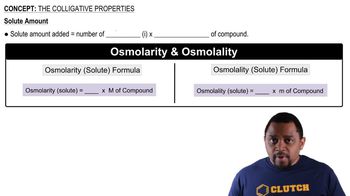
Colligative properties are physical properties of solutions that depend on the number of solute particles in a given amount of solvent, rather than the identity of the solute. These properties include boiling point elevation, freezing point depression, and vapor pressure lowering. Understanding these properties is essential for comparing the effects of different solutes on the physical characteristics of solutions.
추천 영상:
가이드 코스
01:26
Colligative Properties

Freezing Point Depression

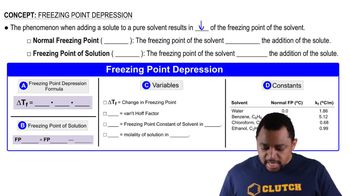
Freezing point depression occurs when a solute is added to a solvent, resulting in a lower freezing point than that of the pure solvent. The extent of freezing point depression is directly proportional to the molality of the solute particles in the solution. In this question, comparing the molalities of sucrose and HNO3 helps determine which solution will have a higher freezing point.
추천 영상:
가이드 코스
01:59
Freezing Point Depression

Boiling Point Elevation

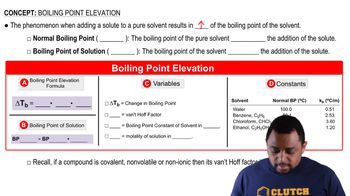
Boiling point elevation is the phenomenon where the boiling point of a solvent increases when a solute is dissolved in it. This effect is also proportional to the number of solute particles in the solution. In the context of the question, the solution with the greater number of solute particles will exhibit a higher boiling point, which can be assessed by considering the dissociation of HNO3 compared to the non-dissociating sucrose.
추천 영상:
가이드 코스
03:05
Boiling Point Elevation