
Ch.13 - Solutions & Their Properties
McMurry - Chemistry 8th Edition
McMurry8th EditionChemistryISBN: 9781292336145당신이 사용하는 게 아니라요?교과서 변경
13장, 문제 10

Which of the following solutions has the lowest vapor pres- sure? (Assume complete dissociation for ionic compounds.) (LO 13.10) (a) An aqueous solution of 0.25 m Ca1NO322 (b) An aqueous solution of 0.30 m sodium chloride (NaCl) (c) A mixture of 50 mL of water and 50 mL of ethanol 1CH3CH2OH2 (d) A mixture of 25 mL of water and 50 mL of ethanol 1CH3CH2OH2

검증된 단계별 안내
1
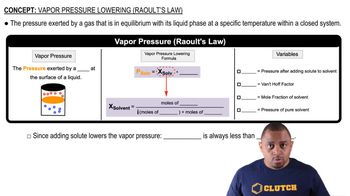
Identify the concept of vapor pressure lowering due to solute addition in solutions, which is explained by Raoult's Law. According to this law, the addition of a solute to a solvent decreases the solvent's vapor pressure proportionally to the concentration of the solute particles.
Recognize that ionic compounds dissociate into ions in solution. For example, Ca(NO3)2 dissociates into three ions: one Ca2+ and two NO3- ions. Similarly, NaCl dissociates into two ions: one Na+ and one Cl-.
Calculate the total number of particles in solution for each option. For (a), 0.25 m Ca(NO3)2 results in 0.75 moles of particles per kilogram of solvent (0.25 m times 3 particles per formula unit). For (b), 0.30 m NaCl results in 0.60 moles of particles per kilogram of solvent (0.30 m times 2 particles per formula unit).
Consider the effect of mixing water with ethanol in options (c) and (d). Ethanol and water form a solution that does not simply follow Raoult's Law due to interactions between ethanol and water molecules, which can affect the overall vapor pressure.
Compare the total number of particles and the nature of the mixtures. The solution with the highest number of solute particles per kilogram of solvent will generally have the lowest vapor pressure. Also, consider the impact of ethanol and water interactions in options (c) and (d).

비슷한 문제에 대한 검증된 영상 답변:

이 영상 해법은 위 문제에 도움이 된다고 튜터들이 추천한 것입니다.
영상 길이:
4m

주요 개념

질문에 올바르게 답하기 위해 반드시 이해해야 하는 핵심 개념들은 다음과 같습니다.

Vapor Pressure

Vapor pressure is the pressure exerted by a vapor in equilibrium with its liquid or solid phase at a given temperature. It reflects the tendency of particles to escape from the liquid phase into the vapor phase. Solutions with solutes generally exhibit lower vapor pressures than pure solvents due to solute-solvent interactions, which hinder the escape of solvent molecules.
추천 영상:
가이드 코스
02:40
Raoult's Law and Vapor Pressure

Colligative Properties

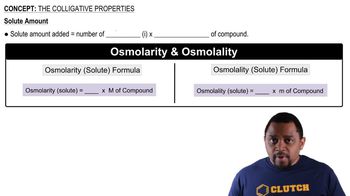
Colligative properties are properties of solutions that depend on the number of solute particles in a given amount of solvent, rather than the identity of the solute. These properties include vapor pressure lowering, boiling point elevation, freezing point depression, and osmotic pressure. The more solute particles present, the greater the effect on the vapor pressure, making it essential to consider the concentration and dissociation of ionic compounds.
추천 영상:
가이드 코스
01:26
Colligative Properties

Ionic Dissociation

Ionic dissociation refers to the process by which ionic compounds separate into their constituent ions when dissolved in a solvent. For example, sodium chloride (NaCl) dissociates into Na+ and Cl- ions. This dissociation increases the total number of solute particles in solution, which is crucial for calculating the colligative properties, including vapor pressure, as it directly influences the extent of vapor pressure lowering.
추천 영상:
관련 실천
교과서 질문
12. A solution contains 4.08 g of chloroform 1CHCl32 and 9.29 g of acetone 1CH3COCH32. The vapor pressures at 35 °C of pure chloroform and pure acetone are 295 torr and 332 torr, respectively. Assuming ideal behavior, calculate the vapor pressure above the solution. (LO 13.12) (a) 256 torr (b) 314 torr (c) 325 torr (d) 462 torr
1059
views
1
rank
교과서 질문
A 10.0 M aqueous solution of NaOH has a density of 1.33 g/cm3 at 25 C. Calculate the mass percent of the NaOH in the solution (a) 53.2% (b) 30.1% (c) 40.0% (d) 13.3%
1527
views
교과서 질문
The molarity of a solution of sodium acetate (CH3COONa) at 20 C is 7.5 M. Use the graph showing the solubility of sodium acetate as a function of temperature to describe the solution. The solution is . (LO 13.7, 13.8)

(a) Saturated (b) Unsaturated (c) Supersaturated (d) Colloidal
1341
views
교과서 질문
How many kilograms of ethylene glycol (automobile anti- freeze, C2H6O2) dissolved in 3.55 kg of water are needed to lower the freezing point of water in an automobile radiator to - 22.0 °C? The molal freezing point depression constant for water is Kf = 1.86 1°C kg2>mol. (LO 13.13) (a) 0.865 kg (b) 0.0420 kg (c) 9.01 kg (d) 2.61 kg
438
views
교과서 질문
A scuba diver is breathing compressed air that is 21% (by volume) oxygen at a depth of 66 ft. beneath the surface. The total pressure at this depth is 3.0 atm. The Henry's law constant (k) for O2 in water at a normal body temperature (37 °C ) is 1.93 * 10-3 mol>(L atm). What is the solubility of O2 in the blood of the diver at 66 ft. beneath the surface? (LO 13.9) (a) 1.22 * 10-3 M (b) 2.76 * 10-2 M (c) 1.22 * 10-1 M (d) 2.76 * 10-1 M
799
views