
Ch.14 - Chemical Kinetics
McMurry - Chemistry 8th Edition
McMurry8th EditionChemistryISBN: 9781292336145당신이 사용하는 게 아니라요?교과서 변경
14장, 문제 11

A key reaction in the upper atmosphere is O31g2 + O1g2 ¡ 2 O21g2 For this process, the energy of activation for the forward reaction, Ea1fwd2, is 19 kJ/mol, and the enthalpy change for the reaction, ΔHrxn, is -392 kJ>mol. What is the energy of activation for the reverse reaction, Ea1reverse2? (LO 14.10) (a) 411 kJ/mol (b) 392 kJ/mol (c) 373 kJ/mol (d) 196 kJ/mol

검증된 단계별 안내
1
Identify the given values: the activation energy for the forward reaction, \( E_{a, \text{fwd}} = 19 \text{ kJ/mol} \), and the enthalpy change for the reaction, \( \Delta H_{\text{rxn}} = -392 \text{ kJ/mol} \).
Recall the relationship between the activation energies of the forward and reverse reactions: \( E_{a, \text{reverse}} = E_{a, \text{fwd}} + \Delta H_{\text{rxn}} \).
Substitute the given values into the equation: \( E_{a, \text{reverse}} = 19 \text{ kJ/mol} + (-392 \text{ kJ/mol}) \).
Simplify the expression to find \( E_{a, \text{reverse}} \).
Compare the calculated \( E_{a, \text{reverse}} \) with the provided options to determine the correct answer.

비슷한 문제에 대한 검증된 영상 답변:

이 영상 해법은 위 문제에 도움이 된다고 튜터들이 추천한 것입니다.
영상 길이:
2m
도움이 되었나요?

주요 개념

질문에 올바르게 답하기 위해 반드시 이해해야 하는 핵심 개념들은 다음과 같습니다.

Activation Energy

Activation energy (Ea) is the minimum energy required for a chemical reaction to occur. It represents the energy barrier that reactants must overcome to transform into products. In this context, the forward reaction has a specific activation energy, which is crucial for understanding how the reaction proceeds and how it can be influenced by temperature and catalysts.
추천 영상:
가이드 코스
02:02
Activity Series Chart

Enthalpy Change (ΔH)

Enthalpy change (ΔH) is the heat content change during a chemical reaction at constant pressure. A negative ΔH indicates that the reaction is exothermic, meaning it releases energy. This value is essential for calculating the activation energy of the reverse reaction, as it helps determine the energy difference between reactants and products.
추천 영상:
가이드 코스
02:34
Enthalpy of Formation

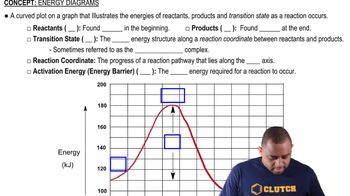
Energy Profile Diagram

An energy profile diagram visually represents the energy changes during a chemical reaction, showing the energy of reactants, products, and the activation energies for both forward and reverse reactions. Understanding this diagram helps in calculating the activation energy for the reverse reaction by using the relationship between the activation energies and the enthalpy change of the reaction.
추천 영상:
가이드 코스
01:57
Energy Diagrams
관련 실천
교과서 질문
Use the following equation and graph to answer questions 1 and 2. Hydrogen iodide decomposes at 410 °C, according the reaction: 2 HI1g2¡H21g2 + I21g2 The graph shows how the concentration of HI changes over time. What is the average rate of loss of HI over the time period 0–40 s (LO 14.1) (a) 7.5 * 10-3 M>s (b) 4.8 * 10-3 M>s (c) 3.0 * 10-2 M>s (d) 3.5 * 10-3 M>s
680
views
교과서 질문
The gas phase decomposition of HI has the following rate law: 2 HI1g2¡H21g2 + I21g2 Rate = k3HI42 At 443 °C, k = 30.1 M-1 min-1. If the initial concentration of HI is 0.010 M, what is the concentration after 1.5 hours? (LO 14.8) (a) 6.9 * 10-3 M (b) 1.8 * 10-3 M (c) 3.6 * 10-4 M (d) 8.9 * 10-4 M
1065
views
교과서 질문
(b) Write the balanced reaction that corresponds to the data in the graph.

838
views
2
rank
교과서 질문
Chlorine monoxide (ClO) decomposes at room temperature according to the reaction 2 ClO1g2¡Cl21g2 + O21g2 The concentration of ClO was monitored over time, and three graphs were made:

What is the rate law for the reaction? (LO 14.9) (a) Rate = k (b) Rate = k3ClO4 (c) Rate = k3ClO42 (d) Rate = k3ClO43 M14_MCMU6230_
384
views
교과서 질문
To answer questions 13–15, refer to the mechanism: H2O21aq2 + I-1aq2¡OH-1aq2 + HOI1aq2 Slower, rate-determining HOI1aq2 + I-1aq2¡OH-1aq2 + I21aq2 Faster 2 OH-1aq2 + 2 H3O+1aq2¡4 H2O1l2 Faster Identify the catalyst and intermediate(s) in the mechanism. (LO 14.12, 14.16) (a) Catalyst = I-, intermediates = OH-, HOI (b) Catalyst = H3O+, intermediate = HOI (c) No catalyst, intermediate = I2 (d) No catalyst, intermediates = OH-, HOI
456
views
1
rank