Ch.14 - Chemical Kinetics
McMurry - Chemistry 8th Edition
McMurry8th EditionChemistryISBN: 9781292336145당신이 사용하는 게 아니라요?교과서 변경
14장, 문제 74

Butadiene C4H6 reacts with itself to form a dimer with the formula C8H12. The reaction is second order in C4H6. Assume the rate constant at a particular temperature is 4.0 × 10^-2 M^-1 s^-1 and the initial concentration of C4H6 is 0.0200 M. (a) What is its molarity after a reaction time of 1.00 h?

검증된 단계별 안내
1
Step 1: Identify the rate law for a second-order reaction. The rate law for a second-order reaction is given by \( \text{Rate} = k[A]^2 \), where \( k \) is the rate constant and \( [A] \) is the concentration of the reactant.
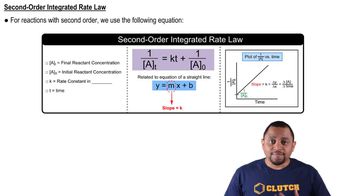
Step 2: Use the integrated rate law for a second-order reaction. The integrated rate law is \( \frac{1}{[A]_t} = \frac{1}{[A]_0} + kt \), where \( [A]_t \) is the concentration at time \( t \), \( [A]_0 \) is the initial concentration, and \( k \) is the rate constant.
Step 3: Substitute the given values into the integrated rate law. Here, \( [A]_0 = 0.0200 \text{ M} \), \( k = 4.0 \times 10^{-2} \text{ M}^{-1} \text{s}^{-1} \), and \( t = 1.00 \text{ h} \). Convert time from hours to seconds: \( 1.00 \text{ h} = 3600 \text{ s} \).
Step 4: Calculate \( \frac{1}{[A]_t} \) using the formula \( \frac{1}{[A]_t} = \frac{1}{0.0200} + (4.0 \times 10^{-2})(3600) \).
Step 5: Solve for \( [A]_t \) by taking the reciprocal of the result from Step 4 to find the concentration of C4H6 after 1.00 hour.

주요 개념

질문에 올바르게 답하기 위해 반드시 이해해야 하는 핵심 개념들은 다음과 같습니다.

Second-Order Reactions

A second-order reaction is one where the rate of reaction is proportional to the square of the concentration of one reactant or to the product of the concentrations of two reactants. For a reaction involving a single reactant, the rate law can be expressed as rate = k[C]^2, where k is the rate constant and [C] is the concentration of the reactant. This type of reaction typically leads to a specific integrated rate law that can be used to calculate concentration changes over time.
추천 영상:
가이드 코스
01:59
Second-Order Reactions

Integrated Rate Law for Second-Order Reactions

The integrated rate law for a second-order reaction can be expressed as 1/[A] = 1/[A]₀ + kt, where [A] is the concentration at time t, [A]₀ is the initial concentration, k is the rate constant, and t is the time elapsed. This equation allows us to determine the concentration of the reactant at any given time, making it essential for solving problems related to concentration changes in second-order kinetics.
추천 영상:
가이드 코스
01:59
Second-Order Reactions

Units of Rate Constant

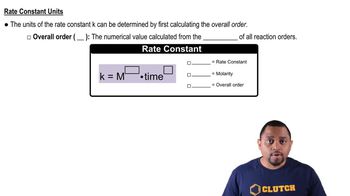
The units of the rate constant (k) for a second-order reaction are M^-1 s^-1, indicating that the rate of reaction depends on the concentration of the reactant squared. Understanding the units is crucial for ensuring that calculations involving the rate constant and concentrations are dimensionally consistent, which is necessary for accurate results in kinetics problems.
추천 영상:
가이드 코스
00:45
Rate Constant Units
관련 실천
교과서 질문
Initial rate data at 25 °C are listed in the table for the reaction NH4 +1aq2 + NO2 -1aq2S N21g2 + 2 H2O1l2 (b) What is the value of the rate constant?

510
views
교과서 질문
What is the half-life (in minutes) of the reaction in Problem 14.74 when the initial C4H6 concentration is 0.0200 M? How many minutes does it take for the concentration of C4H6 to drop from 0.0100 M to 0.0050 M?
834
views
교과서 질문
Trimethylamine and chlorine dioxide react in water in an electron transfer reaction to form the trimethylamine cation and chlorite ion: 1CH323 N1aq2 + ClO21aq2 + H2O1l2S 1CH323 NH+1aq2 + ClO2 -1aq2 + OH-1aq2 Initial rate data obtained at 23 °C are listed in the following table. (b) What would be the initial rate in an experiment with initial concentrations 31CH323 N4 = 4.2 * 10-2 M and 3ClO24 = 3.4 * 10-2 M?
533
views
교과서 질문
The reaction 2NO1g2 + 2 H21g2S N21g2 + 2 H2O1g2 is first order in H2 and second order in NO. Write the rate law, and specify the units of the rate constant.
310
views
교과서 질문
The decomposition of N2O5 is a first-order reaction. At 25 °C, it takes 5.2 h for the concentration to drop from 0.120 M to 0.060 M. How many hours does it take for the concentration to drop from 0.030 M to 0.015 M? From 0.480 M to 0.015 M?
2078
views