
Ch.14 - Chemical Kinetics
McMurry - Chemistry 8th Edition
McMurry8th EditionChemistryISBN: 9781292336145당신이 사용하는 게 아니라요?교과서 변경
14장, 문제 132

Consider the following data for the gas-phase decomposition of NO2: 2 NO2(g) → 2 NO(g) + O2(g) If 0.0050 mol of NO2 is introduced into a 1.0 L flask and allowed to decompose at 650 K, how many seconds does it take for the NO2 concentration to drop to 0.0010 M?
검증된 단계별 안내
1
Step 1: Determine the initial concentration of NO2. Since 0.0050 mol of NO2 is introduced into a 1.0 L flask, the initial concentration [NO2]_0 is 0.0050 M.
Step 2: Identify the order of the reaction. The problem involves the decomposition of NO2, which is often a second-order reaction. Verify this with the given data or assume second-order if not specified.
Step 3: Use the integrated rate law for a second-order reaction: \( \frac{1}{[A]} = kt + \frac{1}{[A]_0} \), where [A] is the concentration at time t, k is the rate constant, and [A]_0 is the initial concentration.
Step 4: Substitute the known values into the integrated rate law. Here, [A]_0 = 0.0050 M, [A] = 0.0010 M, and solve for time t. You will need the rate constant k, which should be provided or determined from additional data.
Step 5: Rearrange the equation to solve for t: \( t = \frac{1}{k} \left( \frac{1}{[A]} - \frac{1}{[A]_0} \right) \). Calculate t using the values from the previous steps.

주요 개념

질문에 올바르게 답하기 위해 반드시 이해해야 하는 핵심 개념들은 다음과 같습니다.

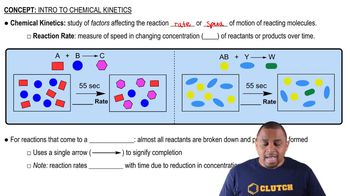
Chemical Kinetics

Chemical kinetics is the study of the rates of chemical reactions and the factors that affect these rates. In this context, understanding how the concentration of NO2 changes over time is crucial for determining the time it takes for the concentration to drop from 0.0050 M to 0.0010 M. The rate of reaction can be influenced by temperature, concentration, and the presence of catalysts.
추천 영상:
가이드 코스
03:06
Chemical Kinetics

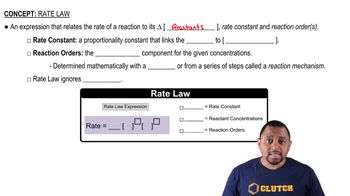
Rate Law

The rate law expresses the relationship between the rate of a chemical reaction and the concentration of its reactants. For the decomposition of NO2, the rate law can be determined experimentally and is essential for calculating the time required for the concentration to decrease. It typically takes the form rate = k[NO2]^n, where k is the rate constant and n is the order of the reaction.
추천 영상:
가이드 코스
01:52
Rate Law Fundamentals

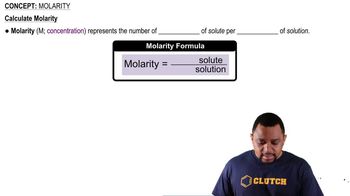
Concentration and Molarity

Concentration refers to the amount of a substance in a given volume of solution, commonly expressed in molarity (M), which is moles of solute per liter of solution. In this problem, the initial concentration of NO2 is 0.0050 M, and the goal is to find the time it takes for this concentration to decrease to 0.0010 M. Understanding how to convert between moles and molarity is essential for solving the problem.
추천 영상:
가이드 코스
00:53
Molarity Concept