
Ch.14 - Chemical Kinetics
McMurry - Chemistry 8th Edition
McMurry8th EditionChemistryISBN: 9781292336145당신이 사용하는 게 아니라요?교과서 변경
14장, 문제 124

Consider the reaction H₂(g) + I₂(g) ⇌ 2 HI(g). The reaction of a fixed amount of H₂ and I₂ is studied in a cylinder fitted with a movable piston. Indicate the effect of each of the following changes on the rate of the reaction. (b) An increase in volume at constant temperature

검증된 단계별 안내
1
Understand the relationship between volume and pressure: According to Boyle's Law, increasing the volume of a gas at constant temperature will decrease its pressure.
Consider the effect of pressure on reaction rate: For gaseous reactions, a decrease in pressure (due to increased volume) generally leads to a decrease in the concentration of reactants.
Apply the concept of concentration and reaction rate: The rate of a chemical reaction is often proportional to the concentration of the reactants. Lower concentration typically results in a slower reaction rate.
Relate the change to the reaction equilibrium: For the reaction H₂(g) + I₂(g) ⇌ 2 HI(g), a decrease in pressure (or increase in volume) will shift the equilibrium position according to Le Chatelier's Principle, potentially affecting the rate at which equilibrium is reached.
Summarize the effect: An increase in volume at constant temperature will likely decrease the rate of the reaction due to the reduced concentration of gaseous reactants.

주요 개념

질문에 올바르게 답하기 위해 반드시 이해해야 하는 핵심 개념들은 다음과 같습니다.

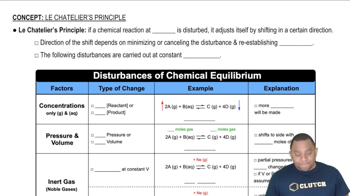
Le Chatelier's Principle

Le Chatelier's Principle states that if a dynamic equilibrium is disturbed by changing the conditions, the system will adjust to counteract the change and restore a new equilibrium. In the context of gas reactions, changes in volume can affect the concentrations of reactants and products, prompting the system to shift in a direction that minimizes the effect of the change.
추천 영상:
가이드 코스
07:32
Le Chatelier's Principle

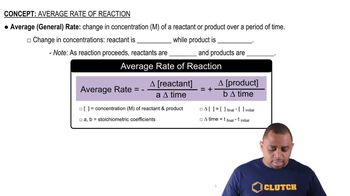
Reaction Rate

The reaction rate refers to the speed at which reactants are converted into products in a chemical reaction. It is influenced by factors such as concentration, temperature, and volume. In gas-phase reactions, increasing the volume decreases the concentration of gaseous reactants, which can slow down the reaction rate as fewer molecules are available to collide and react.
추천 영상:
가이드 코스
02:03
Average Rate of Reaction

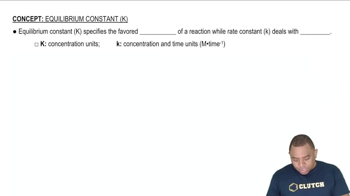
Equilibrium Constant (K)

The equilibrium constant (K) is a numerical value that expresses the ratio of the concentrations of products to reactants at equilibrium for a given reaction at a specific temperature. For the reaction H₂(g) + I₂(g) ⇌ 2 HI(g), changes in volume affect the concentrations of H₂ and I₂, which can shift the position of equilibrium but does not change the value of K unless the temperature changes.
추천 영상:
가이드 코스
01:14
Equilibrium Constant K