Ch.14 - Chemical Kinetics
McMurry - Chemistry 8th Edition
McMurry8th EditionChemistryISBN: 9781292336145당신이 사용하는 게 아니라요?교과서 변경
14장, 문제 127b

Consider the reversible, first-order interconversion of two molecules A and B: where kf = 3.0⨉10-3 s-1 is the rate constant for the forward reaction and kr = 1.0⨉10-3 s-1 is the rate constant for the reverse reaction. We'll see in Chapter 15 that a reaction does not go to completion but instead reaches a state of equilibrium with comparable concentrations of reactants and products if the rate constants kf and kr have comparable values.
(b) Draw a qualitative graph that shows how the rates of the forward and reverse reactions vary with time.

검증된 단계별 안내
1
Start by understanding that the forward reaction rate is given by the expression: rate_{forward} = k_f [A], where k_f is the rate constant for the forward reaction and [A] is the concentration of A.
Similarly, the reverse reaction rate is given by: rate_{reverse} = k_r [B], where k_r is the rate constant for the reverse reaction and [B] is the concentration of B.
At the beginning of the reaction, the concentration of A is at its maximum, and the concentration of B is zero, so the forward reaction rate is at its maximum, and the reverse reaction rate is zero.
As time progresses, the concentration of A decreases while the concentration of B increases, causing the forward reaction rate to decrease and the reverse reaction rate to increase.
Eventually, the system reaches equilibrium where the forward and reverse reaction rates become equal, resulting in no net change in the concentrations of A and B. On the graph, this is where the two rate curves intersect and level off.

비슷한 문제에 대한 검증된 영상 답변:

이 영상 해법은 위 문제에 도움이 된다고 튜터들이 추천한 것입니다.
영상 길이:
4m
도움이 되었나요?

주요 개념

질문에 올바르게 답하기 위해 반드시 이해해야 하는 핵심 개념들은 다음과 같습니다.

Reversible Reactions

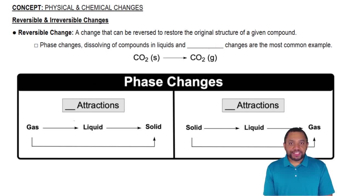
Reversible reactions are chemical processes that can proceed in both the forward and reverse directions. In such reactions, the products can react to form the original reactants, allowing the system to reach a state of dynamic equilibrium where the rates of the forward and reverse reactions are equal. This concept is crucial for understanding how concentrations of reactants and products change over time.
추천 영상:
가이드 코스
03:42
Reversible Changes in Matter

Rate Constants

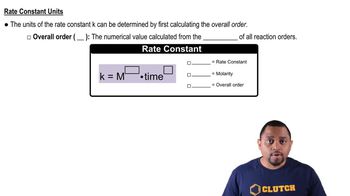
Rate constants (k) are specific values that quantify the speed of a reaction at a given temperature. For a first-order reaction, the rate constant determines how quickly reactants are converted to products. In the context of the question, the forward rate constant (kf) and the reverse rate constant (kr) indicate the relative speeds of the two directions of the reaction, influencing the equilibrium position.
추천 영상:
가이드 코스
00:45
Rate Constant Units

Equilibrium

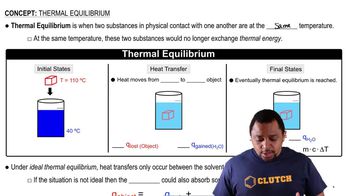
Chemical equilibrium occurs when the rates of the forward and reverse reactions are equal, resulting in constant concentrations of reactants and products over time. At equilibrium, the system is dynamic, meaning that reactions continue to occur, but there is no net change in concentration. Understanding equilibrium is essential for predicting the behavior of reversible reactions and interpreting the qualitative graph of reaction rates.
추천 영상:
가이드 코스
02:35
Thermal Equilibrium
관련 실천
교과서 질문
The half-life for the first-order decomposition of N2O4 is 1.3 * 10-5 s. N2O41g2S 2 NO21g2 If N2O4 is introduced into an evacuated flask at a pressure of 17.0 mm Hg, how many seconds are required for the pressure of NO2 to reach 1.3 mm Hg?
1180
views
교과서 질문

Consider the following concentration–time data for the reaction of iodide ion and hypochlorite ion (OCl-). The products are chloride ion and hypoiodite ion (OI-).

(b) Determine the rate law, and calculate the value of the rate constant.

673
views
교과서 질문

Consider the reversible, first-order interconversion of two molecules A and B: where kf = 3.0⨉10-3 s-1 is the rate constant for the forward reaction and kr = 1.0⨉10-3 s-1 is the rate constant for the reverse reaction. We'll see in Chapter 15 that a reaction does not go to completion but instead reaches a state of equilibrium with comparable concentrations of reactants and products if the rate constants kf and kr have comparable values.

(c) What are the relative concentrations of B and A when the rates of the forward and reverse reactions become equal?

333
views
교과서 질문

Consider the reversible, first-order interconversion of two molecules A and B: where kf = 3.0⨉10-3 s-1 is the rate constant for the forward reaction and kr = 1.0⨉10-3 s-1 is the rate constant for the reverse reaction. We'll see in Chapter 15 that a reaction does not go to completion but instead reaches a state of equilibrium with comparable concentrations of reactants and products if the rate constants kf and kr have comparable values.

(a) What are the rate laws for the forward and reverse reactions?

453
views
교과서 질문
Assume that you are studying the first-order conversion of a reactant X to products in a reaction vessel with a constant volume of 1.000 L. At 1 p.m., you start the reaction at 25 °C with 1.000 mol of X. At 2 p.m., you find that 0.600 mol of X remains, and you immediately increase the temperature of the reaction mixture to 35 °C. At 3 p.m., you discover that 0.200 mol of X is still present. You want to finish the reaction by 4 p.m. but need to continue it until only 0.010 mol of X remains, so you decide to increase the temperature once again. What is the minimum temperature required to convert all but 0.010 mol of X to products by 4 p.m.?
486
views
교과서 질문

Consider the following concentration–time data for the reaction of iodide ion and hypochlorite ion (OCl-). The products are chloride ion and hypoiodite ion (OI-).

(d) Propose a mechanism that is consistent with the rate law, and express the rate constant in terms of the rate constants for the elementary steps in your mechanism. (Hint: Transfer of an H+ ion between H2O and OCl- is a rapid reversible reaction.)

288
views