
Ch.15 - Chemical Equilibrium
McMurry - Chemistry 8th Edition
McMurry8th EditionChemistryISBN: 9781292336145당신이 사용하는 게 아니라요?교과서 변경
15장, 문제 156

A 79.2 g chunk of dry ice (solid CO2) and 30.0 g of graphite (carbon) were placed in an empty 5.00-L container, and the mixture was heated to achieve equilibrium. The reaction is CO 1g2 + C s ∆ 2 CO g (b) What is the value of Kp at 1100 K if the gas density at 1100 K is 16.9 g/L?

검증된 단계별 안내
1
Identify the reaction: \( \text{CO}(g) + \text{C}(s) \rightleftharpoons 2\text{CO}(g) \). Note that carbon in solid form does not appear in the equilibrium expression.
Use the ideal gas law to find the total moles of gas at equilibrium. The gas density is given as 16.9 g/L, and the volume is 5.00 L. Calculate the total mass of the gas using density and volume, then convert this mass to moles using the molar mass of CO.
Set up the equilibrium expression for \( K_p \): \( K_p = \frac{P_{\text{CO}}^2}{P_{\text{CO}}} \). Since the reaction involves gases, use partial pressures in the expression.
Calculate the partial pressure of CO at equilibrium. Use the moles of CO found from the ideal gas law and the volume of the container to find the partial pressure using \( P = \frac{nRT}{V} \).
Substitute the partial pressures into the equilibrium expression to solve for \( K_p \).

비슷한 문제에 대한 검증된 영상 답변:

이 영상 해법은 위 문제에 도움이 된다고 튜터들이 추천한 것입니다.
영상 길이:
8m

주요 개념

질문에 올바르게 답하기 위해 반드시 이해해야 하는 핵심 개념들은 다음과 같습니다.

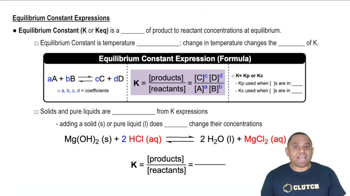
Equilibrium Constant (Kp)

The equilibrium constant, Kp, is a numerical value that expresses the ratio of the partial pressures of the products to the reactants at equilibrium for a given reaction at a specific temperature. It is calculated using the formula Kp = (P_CO)^2 / (P_C)^1, where P_CO is the partial pressure of carbon monoxide and P_C is the partial pressure of carbon. Understanding Kp is essential for predicting the direction of the reaction and the concentrations of reactants and products at equilibrium.
추천 영상:
가이드 코스
03:20
Equilibrium Constant Expressions

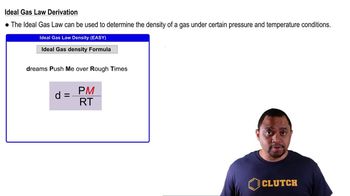
Gas Density and Ideal Gas Law

Gas density is defined as the mass of gas per unit volume, typically expressed in grams per liter (g/L). The ideal gas law, PV = nRT, relates pressure (P), volume (V), number of moles (n), the ideal gas constant (R), and temperature (T). By using the gas density provided, one can determine the number of moles of gas present in the container, which is crucial for calculating the partial pressures needed to find Kp.
추천 영상:
가이드 코스
01:03
Density from Ideal Gas Law

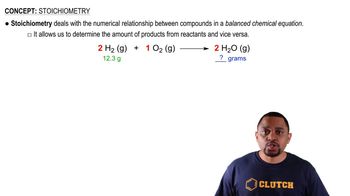
Stoichiometry of the Reaction

Stoichiometry involves the calculation of reactants and products in chemical reactions based on balanced equations. In this case, the reaction between solid carbon and carbon dioxide to form carbon monoxide must be balanced to determine the mole ratios of the reactants and products. This understanding is vital for calculating the concentrations of each species at equilibrium, which directly influences the value of Kp.
추천 영상:
가이드 코스
01:16
Stoichiometry Concept