Ch.15 - Chemical Equilibrium

McMurry8th EditionChemistryISBN: 9781292336145
당신이 사용하는 게 아니라요?교과서 변경다른 교과서를 선택하세요
TOC.tableOfContents
- Ch.1 - Chemical Tools: Experimentation & Measurement170
- Ch.2 - Atoms, Molecules & Ions160
- Ch.3 - Mass Relationships in Chemical Reactions169
- Ch.4 - Reactions in Aqueous Solution199
- Ch.5 - Periodicity & Electronic Structure of Atoms102
- Ch.6 - Ionic Compounds: Periodic Trends and Bonding Theory92
- Ch.7 - Covalent Bonding and Electron-Dot Structures61
- Ch.8 - Covalent Compounds: Bonding Theories and Molecular Structure59
- Ch.9 - Thermochemistry: Chemical Energy122
- Ch.10 - Gases: Their Properties & Behavior155
- Ch.11 - Liquids & Phase Changes54
- Ch.12 - Solids and Solid-State Materials73
- Ch.13 - Solutions & Their Properties120
- Ch.14 - Chemical Kinetics98
- Ch.15 - Chemical Equilibrium125
- Ch.16 - Aqueous Equilibria: Acids & Bases110
- Ch.17 - Applications of Aqueous Equilibria147
- Ch.18 - Thermodynamics: Entropy, Free Energy & Equilibrium86
- Ch.19 - Electrochemistry154
- Ch.20 - Nuclear Chemistry96
- Ch.21 - Transition Elements and Coordination Chemistry156
- Ch.22 - The Main Group Elements187
- Ch.23 - Organic and Biological Chemistry51

15장, 문제 106
At 100 °C, Kc = 4.72 for the reaction 2 NO21g2 ∆ N2O41g2. An empty 10.0-L flask is filled with 4.60 g of NO2 at 100 °C. What is the total pressure in the flask at equilibrium?
 검증된 단계별 안내
1
Calculate the number of moles of NO2 initially present using the molar mass of NO2. The molar mass of NO2 is approximately 46.0 g/mol.
Use the ideal gas law to calculate the initial pressure of NO2 in the flask. The ideal gas law is PV = nRT, where P is the pressure, V is the volume, n is the number of moles, R is the gas constant (0.0821 L·atm/mol·K), and T is the temperature in Kelvin.
Set up the ICE table (Initial, Change, Equilibrium) for the reaction: 2 NO2(g) ⇌ N2O4(g). Fill in the initial concentrations, the change in concentrations as the reaction proceeds towards equilibrium, and the equilibrium concentrations.
Write the expression for the equilibrium constant Kc and substitute the equilibrium concentrations from the ICE table. Solve for the unknowns, which represent the changes in concentration due to the reaction reaching equilibrium.
Calculate the total pressure at equilibrium by adding the partial pressures of NO2 and N2O4. Use the equilibrium concentrations and the ideal gas law to find the partial pressures.
비슷한 문제에 대한 검증된 영상 답변:
이 영상 해법은 위 문제에 도움이 된다고 튜터들이 추천한 것입니다.

영상 길이:
13m주요 개념
질문에 올바르게 답하기 위해 반드시 이해해야 하는 핵심 개념들은 다음과 같습니다.
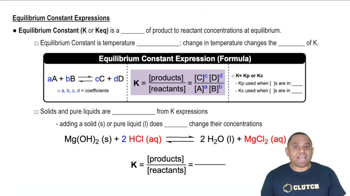
Equilibrium Constant (Kc)
The equilibrium constant, Kc, quantifies the ratio of the concentrations of products to reactants at equilibrium for a given reaction at a specific temperature. For the reaction 2 NO2(g) ⇌ N2O4(g), Kc = [N2O4]/[NO2]^2. A Kc value greater than 1 indicates that at equilibrium, products are favored over reactants.
추천 영상:
가이드 코스
 03:20
03:20
Equilibrium Constant Expressions
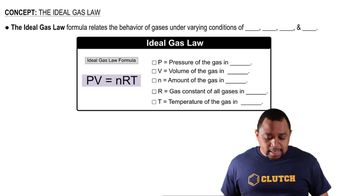
Ideal Gas Law
The Ideal Gas Law relates the pressure, volume, temperature, and number of moles of a gas through the equation PV = nRT. This law is essential for calculating the total pressure in a gas system, where P is pressure, V is volume, n is the number of moles, R is the ideal gas constant, and T is temperature in Kelvin.
추천 영상:
가이드 코스
 01:15
01:15Ideal Gas Law Formula
Stoichiometry of Gaseous Reactions
Stoichiometry involves the quantitative relationships between reactants and products in a chemical reaction. In the context of gaseous reactions, it helps determine the moles of gases involved at equilibrium, which is crucial for calculating total pressure. Understanding the stoichiometric coefficients allows for the correct application of Kc to find equilibrium concentrations.
추천 영상:
가이드 코스
 01:16
01:16Stoichiometry Concept
관련 실천