Ch.15 - Chemical Equilibrium
McMurry - Chemistry 8th Edition
McMurry8th EditionChemistryISBN: 9781292336145당신이 사용하는 게 아니라요?교과서 변경
15장, 문제 118c

Consider the following equilibrium: Ag+ (aq) + Cl-(aq) → AgCl(s) Use Le Châtelier's principle to predict how the amount of solid silver chloride will change when the equilibrium is disturbed by: (c) Adding NO3, which reacts with Ag+ to form the complex ion Ag(NH3)2+

검증된 단계별 안내
1
Identify the initial equilibrium reaction: Ag^+ (aq) + Cl^- (aq) ⇌ AgCl(s).
Recognize that adding NO_3^- will not directly affect the equilibrium, but the formation of Ag(NH_3)_2^+ from Ag^+ and NH_3 will.
Understand that the formation of Ag(NH_3)_2^+ reduces the concentration of free Ag^+ ions in the solution.
Apply Le Châtelier's principle: the system will shift to counteract the change, meaning it will shift to the left to produce more Ag^+ ions.
Conclude that as the equilibrium shifts to the left, the amount of solid AgCl will decrease as it dissolves to release more Ag^+ ions.

비슷한 문제에 대한 검증된 영상 답변:

이 영상 해법은 위 문제에 도움이 된다고 튜터들이 추천한 것입니다.
영상 길이:
2m

주요 개념

질문에 올바르게 답하기 위해 반드시 이해해야 하는 핵심 개념들은 다음과 같습니다.

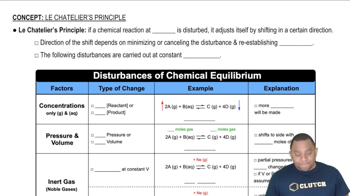
Le Châtelier's Principle

Le Châtelier's Principle states that if a dynamic equilibrium is disturbed by changing the conditions, the position of equilibrium shifts to counteract the change. This means that if a reactant or product concentration is altered, the system will adjust to restore equilibrium, either by favoring the forward or reverse reaction.
추천 영상:
가이드 코스
07:32
Le Chatelier's Principle

Equilibrium Constant

The equilibrium constant (K) quantifies the ratio of the concentrations of products to reactants at equilibrium for a given reaction at a specific temperature. For the reaction Ag<sup>+</sup> + Cl<sup>-</sup> ⇌ AgCl, the equilibrium constant expression is K = [AgCl]/([Ag<sup>+</sup>][Cl<sup>-</sup>]). Changes in concentration of reactants or products will affect the value of K and the position of equilibrium.
추천 영상:
가이드 코스
01:14
Equilibrium Constant K

Complex Ion Formation

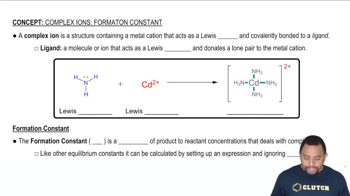
Complex ion formation occurs when a metal ion binds with one or more ligands, resulting in a new species. In this case, the addition of NO<sub>3</sub> leads to the formation of the complex ion Ag(NH<sub>3</sub>)<sub>2</sub><sup>+</sup>, which decreases the concentration of free Ag<sup>+</sup> ions in solution. This shift in concentration affects the equilibrium position, potentially increasing the amount of solid AgCl formed.
추천 영상:
가이드 코스
02:20
Complex Ions and Formation Constant