
Ch.15 - Chemical Equilibrium
McMurry - Chemistry 8th Edition
McMurry8th EditionChemistryISBN: 9781292336145당신이 사용하는 게 아니라요?교과서 변경
15장, 문제 13

For the general, single-step reaction A1g2 + B1g2 ∆ AB1g2, Kc = 4.5 * 10-6, which of the following statements is true? (LO 15.16) (a) Ea 1forward2 6 Ea 1reverse2 (b) The equilibrium mixture contains mostly products. (c) kr 7 kf (d) The reaction is exothermic.

검증된 단계별 안내
1
First, let's understand what each statement means. (a) is saying that the activation energy for the forward reaction is greater than the activation energy for the reverse reaction. (b) is saying that at equilibrium, the concentration of the products is greater than the concentration of the reactants. (c) is saying that the rate constant for the reverse reaction is greater than the rate constant for the forward reaction. (d) is saying that the reaction releases heat.
Next, let's look at the given equilibrium constant, Kc. Kc is a measure of the ratio of the concentrations of the products to the reactants at equilibrium. A small Kc (like 4.5 * 10^-6) means that at equilibrium, the concentration of the reactants is much greater than the concentration of the products.
From this, we can conclude that statement (b) is false. The equilibrium mixture does not contain mostly products, it contains mostly reactants.
Statement (c) could be true. If the rate constant for the reverse reaction is greater than the rate constant for the forward reaction, this would mean that the reaction favors the reactants, which is consistent with a small Kc.
Statement (a) could also be true. If the activation energy for the forward reaction is greater than the activation energy for the reverse reaction, this would mean that it is harder for the reaction to proceed in the forward direction, which is also consistent with a small Kc. Statement (d) cannot be determined from the given information. The heat of the reaction (whether it is exothermic or endothermic) does not directly relate to the value of Kc.

비슷한 문제에 대한 검증된 영상 답변:

이 영상 해법은 위 문제에 도움이 된다고 튜터들이 추천한 것입니다.
영상 길이:
2m

주요 개념

질문에 올바르게 답하기 위해 반드시 이해해야 하는 핵심 개념들은 다음과 같습니다.

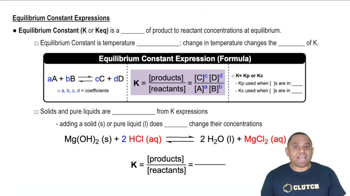
Equilibrium Constant (Kc)

The equilibrium constant, Kc, quantifies the ratio of the concentrations of products to reactants at equilibrium for a given reaction at a specific temperature. A small Kc value, such as 4.5 * 10^-6, indicates that at equilibrium, the reaction favors the reactants over the products, suggesting that the formation of products is not favored under the given conditions.
추천 영상:
가이드 코스
03:20
Equilibrium Constant Expressions

Activation Energy (Ea)

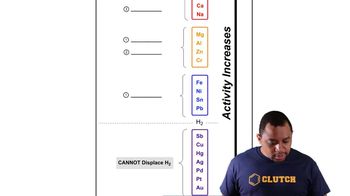
Activation energy (Ea) is the minimum energy required for a reaction to occur. In the context of forward and reverse reactions, if Ea for the forward reaction is greater than for the reverse, it implies that the forward reaction is less favorable. This concept is crucial for understanding the kinetics of the reaction and how it relates to the equilibrium position.
추천 영상:
가이드 코스
02:02
Activity Series Chart

Exothermic vs. Endothermic Reactions

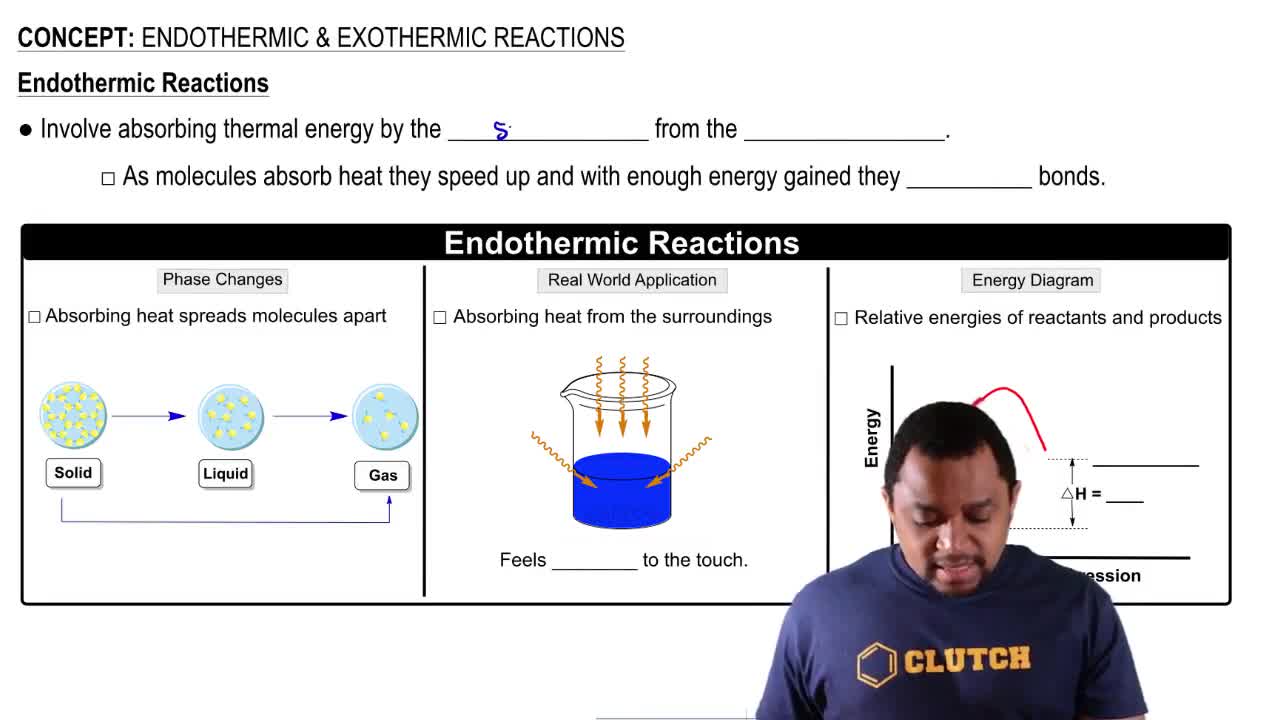
Exothermic reactions release energy, typically in the form of heat, while endothermic reactions absorb energy. The nature of the reaction (exothermic or endothermic) can influence the equilibrium position and the values of Kc. Understanding whether a reaction is exothermic or endothermic helps predict how changes in temperature will affect the equilibrium state.
추천 영상:
가이드 코스
02:30
Endothermic & Exothermic Reactions