
Ch.15 - Chemical Equilibrium
McMurry - Chemistry 8th Edition
McMurry8th EditionChemistryISBN: 9781292336145당신이 사용하는 게 아니라요?교과서 변경
15장, 문제 6

If Kc = 7.5 * 10^-9 at 1000 K for the reaction N2(g) + O2(g) ⇌ 2 NO(g), give the value of Kc at 1000 K for the reaction 2 N2(g) + 2 O2(g) ⇌ 4 NO(g)

검증된 단계별 안내
1
Step 1: Understand that the equilibrium constant \( K_c \) is dependent on the stoichiometry of the reaction. When the coefficients of a balanced chemical equation are multiplied by a factor, the equilibrium constant is raised to the power of that factor.
Step 2: Identify the original reaction: \( \text{N}_2(g) + \text{O}_2(g) \rightleftharpoons 2 \text{NO}(g) \) with \( K_c = 7.5 \times 10^{-9} \).
Step 3: Recognize that the new reaction is \( 2 \text{N}_2(g) + 2 \text{O}_2(g) \rightleftharpoons 4 \text{NO}(g) \), which is the original reaction multiplied by 2.
Step 4: Apply the rule for modifying \( K_c \): Since the reaction is multiplied by 2, raise the original \( K_c \) to the power of 2. This means \( K_{c, \text{new}} = (K_c)^2 \).
Step 5: Substitute the given \( K_c \) value into the equation: \( K_{c, \text{new}} = (7.5 \times 10^{-9})^2 \). This will give you the new equilibrium constant for the modified reaction.

주요 개념

질문에 올바르게 답하기 위해 반드시 이해해야 하는 핵심 개념들은 다음과 같습니다.

Equilibrium Constant (Kc)

The equilibrium constant (Kc) is a numerical value that expresses the ratio of the concentrations of products to reactants at equilibrium for a given reaction at a specific temperature. It is calculated using the formula Kc = [products]^coefficients / [reactants]^coefficients. A larger Kc value indicates a greater concentration of products at equilibrium, while a smaller Kc suggests a higher concentration of reactants.
추천 영상:
가이드 코스
03:20
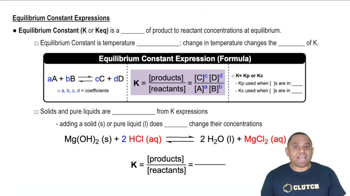
Equilibrium Constant Expressions

Effect of Stoichiometry on Kc

The value of the equilibrium constant is affected by the stoichiometry of the reaction. If the coefficients in a balanced chemical equation are multiplied by a factor, the equilibrium constant is raised to the power of that factor. For example, if the reaction is doubled, Kc for the new reaction is Kc^2. This principle is crucial for determining Kc for reactions with different stoichiometric coefficients.
추천 영상:
가이드 코스
02:18
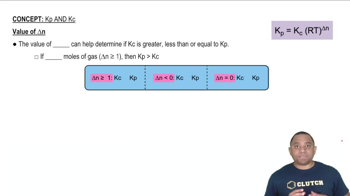
Kp vs Kc Relationship

Reversibility of Reactions

Chemical reactions can proceed in both forward and reverse directions, and the equilibrium constant reflects this reversibility. For a reaction A ⇌ B, the equilibrium constant Kc for the forward reaction is the inverse of Kc for the reverse reaction. Understanding this concept helps in calculating Kc for related reactions, as it allows for the application of the relationship between the original and modified reactions.
추천 영상:
가이드 코스
03:42
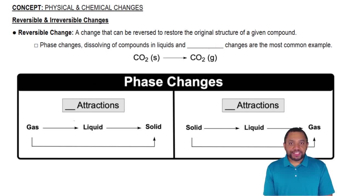
Reversible Changes in Matter