
Ch.15 - Chemical Equilibrium
McMurry - Chemistry 8th Edition
McMurry8th EditionChemistryISBN: 9781292336145당신이 사용하는 게 아니라요?교과서 변경
15장, 문제 126

Methanol (CH3OH) is manufactured by the reaction of carbon monoxide with hydrogen in the presence of a Cu/ZnO/Al2O3 catalyst: CO(g) + 2H2(g) ⇌ CH3OH(g) ΔH° = -91 kJ. Does the amount of methanol increase, decrease, or remain the same when an equilibrium mixture of reactants and products is subjected to the following changes? (a) The temperature is increased. (b) CO is added. (c) Helium is added. (d) The catalyst is removed.

검증된 단계별 안내
1
Step 1: Consider the effect of temperature on the equilibrium. Since the reaction is exothermic (ΔH° = -91 kJ), increasing the temperature will shift the equilibrium to favor the endothermic direction, which is the reverse reaction. This will decrease the amount of methanol.
Step 2: Analyze the effect of adding CO. According to Le Chatelier's principle, adding more CO will shift the equilibrium to the right to counteract the change, increasing the amount of methanol produced.
Step 3: Evaluate the impact of adding helium. Adding an inert gas like helium at constant volume does not change the partial pressures of the reactants or products, so the equilibrium position remains unchanged, and the amount of methanol stays the same.
Step 4: Consider the role of the catalyst. Removing the catalyst will slow down the rate at which equilibrium is reached but does not affect the position of the equilibrium. Therefore, the amount of methanol at equilibrium remains the same.
Step 5: Summarize the effects: (a) Methanol decreases with increased temperature, (b) Methanol increases with added CO, (c) Methanol remains the same with added helium, (d) Methanol remains the same if the catalyst is removed.

주요 개념

질문에 올바르게 답하기 위해 반드시 이해해야 하는 핵심 개념들은 다음과 같습니다.

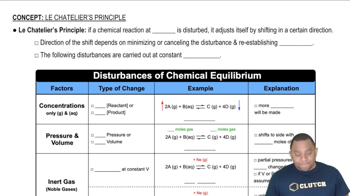
Le Chatelier's Principle

Le Chatelier's Principle states that if a dynamic equilibrium is disturbed by changing the conditions, the position of equilibrium shifts to counteract the change. This principle helps predict how the concentration of reactants and products will change in response to alterations in temperature, pressure, or concentration.
추천 영상:
가이드 코스
07:32
Le Chatelier's Principle

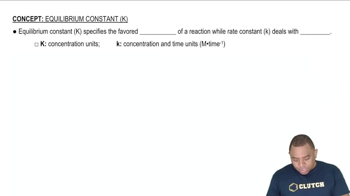
Equilibrium Constant (K)

The equilibrium constant (K) is a numerical value that expresses the ratio of the concentrations of products to reactants at equilibrium for a given reaction at a specific temperature. Changes in concentration or temperature can affect the value of K, thereby influencing the position of equilibrium and the amounts of reactants and products present.
추천 영상:
가이드 코스
01:14
Equilibrium Constant K

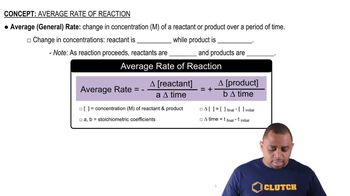
Catalysts and Reaction Rates

A catalyst is a substance that increases the rate of a chemical reaction without being consumed in the process. While catalysts speed up the attainment of equilibrium, they do not affect the position of equilibrium or the concentrations of reactants and products at equilibrium, as they influence both forward and reverse reactions equally.
추천 영상:
가이드 코스
02:03
Average Rate of Reaction