
Ch.15 - Chemical Equilibrium
McMurry - Chemistry 8th Edition
McMurry8th EditionChemistryISBN: 9781292336145당신이 사용하는 게 아니라요?교과서 변경
15장, 문제 94

Recalculate the equilibrium concentrations in Problem 15.93 if the initial concentrations are 2.24 M N2 and 0.56 M O2. (This N2>O2 concentration ratio is the ratio found in air.)

검증된 단계별 안내
1
Identify the balanced chemical equation for the reaction involving N2 and O2. For example, if the reaction is N2 + O2 ⇌ 2NO, write it down.
Write the expression for the equilibrium constant (Kc) based on the balanced equation. For the example reaction, Kc = [NO]^2 / ([N2][O2]).
Set up an ICE (Initial, Change, Equilibrium) table to track the concentrations of reactants and products. Start with the initial concentrations: [N2] = 2.24 M, [O2] = 0.56 M, and assume [NO] = 0 M initially.
Define the change in concentration for each species in terms of a variable, usually x. For example, if x is the change in concentration of NO, then the changes for N2 and O2 would be -x/2 and -x/2, respectively, based on stoichiometry.
Substitute the equilibrium concentrations from the ICE table into the Kc expression and solve for x. Use this value to find the equilibrium concentrations of all species.

비슷한 문제에 대한 검증된 영상 답변:

이 영상 해법은 위 문제에 도움이 된다고 튜터들이 추천한 것입니다.
영상 길이:
3m
도움이 되었나요?

주요 개념

질문에 올바르게 답하기 위해 반드시 이해해야 하는 핵심 개념들은 다음과 같습니다.

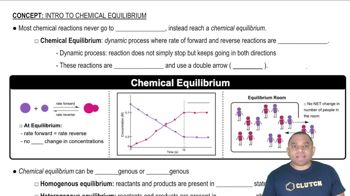
Chemical Equilibrium

Chemical equilibrium occurs when the rates of the forward and reverse reactions are equal, resulting in constant concentrations of reactants and products. At equilibrium, the system's composition remains unchanged over time, and the equilibrium constant (K) can be used to express the ratio of product concentrations to reactant concentrations at this state.
추천 영상:
가이드 코스
04:21
Chemical Equilibrium Concepts

Equilibrium Constant (K)

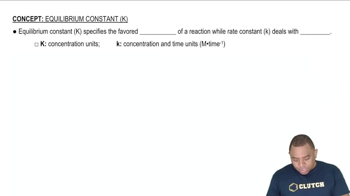
The equilibrium constant (K) is a numerical value that expresses the ratio of the concentrations of products to reactants at equilibrium, each raised to the power of their coefficients in the balanced chemical equation. It provides insight into the position of equilibrium; a large K indicates a reaction that favors products, while a small K suggests reactants are favored.
추천 영상:
가이드 코스
01:14
Equilibrium Constant K

Initial Concentrations and Changes

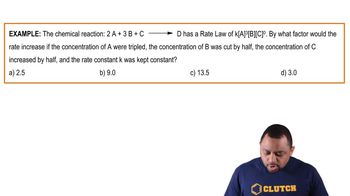
In equilibrium problems, the initial concentrations of reactants and products are crucial for determining how the system will shift to reach equilibrium. Changes in concentration, often represented by 'x', are calculated based on the stoichiometry of the reaction, allowing for the determination of equilibrium concentrations by applying the initial values and the changes that occur as the system stabilizes.
추천 영상:
가이드 코스
02:10
Concentration Changes and Rate Law Example