
Ch.15 - Chemical Equilibrium
McMurry - Chemistry 8th Edition
McMurry8th EditionChemistryISBN: 9781292336145당신이 사용하는 게 아니라요?교과서 변경
15장, 문제 161

The equilibrium constant for the dimerization of acetic acid in benzene solution is 1.51 * 102 at 25 °C. 2 CH3CO2H ∆ 1CH3CO2H22 Kc = 1.51 * 102 at 25 °C (b) What is the osmotic pressure of the solution at 25 °C?

검증된 단계별 안내
1
Identify the relevant formula for osmotic pressure: \( \Pi = iMRT \), where \( \Pi \) is the osmotic pressure, \( i \) is the van't Hoff factor, \( M \) is the molarity, \( R \) is the ideal gas constant, and \( T \) is the temperature in Kelvin.
Determine the van't Hoff factor \( i \). For the dimerization reaction \( 2 \text{CH}_3\text{CO}_2\text{H} \rightleftharpoons (\text{CH}_3\text{CO}_2\text{H})_2 \), the equilibrium constant \( K_c = 1.51 \times 10^2 \) suggests that the reaction favors the dimer formation. Calculate \( i \) based on the extent of dimerization.
Convert the temperature from Celsius to Kelvin: \( T = 25 + 273.15 = 298.15 \text{ K} \).
Assume an initial concentration of acetic acid and use the equilibrium constant \( K_c \) to find the equilibrium concentrations of monomer and dimer. This will help determine the effective molarity \( M \) of particles in solution.
Substitute the values of \( i \), \( M \), \( R \) (0.0821 L atm K⁻¹ mol⁻¹), and \( T \) into the osmotic pressure formula to find \( \Pi \).

비슷한 문제에 대한 검증된 영상 답변:

이 영상 해법은 위 문제에 도움이 된다고 튜터들이 추천한 것입니다.
영상 길이:
13m
도움이 되었나요?

주요 개념

질문에 올바르게 답하기 위해 반드시 이해해야 하는 핵심 개념들은 다음과 같습니다.

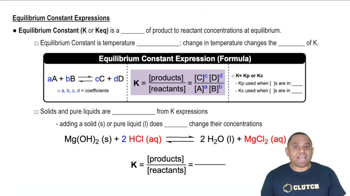
Equilibrium Constant (Kc)

The equilibrium constant (Kc) quantifies the ratio of the concentrations of products to reactants at equilibrium for a given reaction at a specific temperature. In the case of dimerization, Kc indicates how much acetic acid exists as dimers versus monomers in solution. A higher Kc value suggests a greater tendency for the formation of dimers.
추천 영상:
가이드 코스
03:20
Equilibrium Constant Expressions

Osmotic Pressure

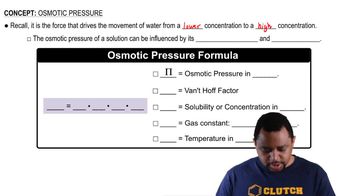
Osmotic pressure is the pressure required to prevent the flow of solvent into a solution through a semipermeable membrane. It is directly related to the concentration of solute particles in the solution, as described by the formula π = iCRT, where π is osmotic pressure, i is the van 't Hoff factor, C is molarity, R is the ideal gas constant, and T is temperature in Kelvin.
추천 영상:
가이드 코스
01:13
Osmotic Pressure Formula

Dimerization

Dimerization is a chemical process where two molecules combine to form a larger, more complex molecule called a dimer. In the context of acetic acid, this process affects the concentration of acetic acid in solution, which in turn influences the osmotic pressure. Understanding the extent of dimerization is crucial for calculating the effective concentration of solute particles in the solution.
관련 실천
교과서 질문

Consider the sublimation of mothballs at 27 °C in a room having dimensions 8.0 ft ⨉ 10.0 ft ⨉ 8.0 ft. Assume that the mothballs are pure solid naphthalene (density 1.16 g/cm3) and that they are spheres with a diameter of 12.0 mm. The equilibrium constant Kc for the sublimation of naphthalene is 5.40⨉10-6 at 27 °C. C10H8(s) ⇌ C10H8(g) (b) How many mothballs are required to saturate the room with gaseous naphthalene?

395
views
교과서 질문
Ozone is unstable with respect to decomposition to ordi-nary oxygen: 2 O31g2 ∆ 3 O21g2 Kp = 1.3 * 1057 How many O3 molecules are present at equilibrium in 10 mil-lion cubic meters of air at 25 °C and 720 mm Hg pressure?
552
views
교과서 질문

Consider the sublimation of mothballs at 27 °C in a room having dimensions 8.0 ft ⨉ 10.0 ft ⨉ 8.0 ft. Assume that the mothballs are pure solid naphthalene (density 1.16 g/cm3) and that they are spheres with a diameter of 12.0 mm. The equilibrium constant Kc for the sublimation of naphthalene is 5.40⨉10-6 at 27 °C. C10H8(s) ⇌ C10H8(g) (a) When excess mothballs are present, how many gaseous naphthalene molecules are in the room at equilibrium?

284
views
교과서 질문

For the decomposition reaction PCl5(g) ⇌ PCl3(g) + Cl2(g), Kp = 381 at 600 K and Kc = 46.9 at 700 K. (a) Is the reaction endothermic or exothermic? Explain. Does your answer agree with what you would predict based on bond energies?

305
views
교과서 질문

For the decomposition reaction PCl5(g) ⇌ PCl3(g) + Cl2(g), Kp = 381 at 600 K and Kc = 46.9 at 700 K. (b) If 1.25 g of PCl5 is introduced into an evacuated 0.500-L flask at 700 K and the decomposition reaction is allowed to reach equilibrium, what percent of the PCl5 will decompose and what will be the total pressure in the flask?

504
views