Ch.15 - Chemical Equilibrium
McMurry - Chemistry 8th Edition
McMurry8th EditionChemistryISBN: 9781292336145당신이 사용하는 게 아니라요?교과서 변경
15장, 문제 50

The following pictures represent the initial and equilibrium states for the exothermic decomposition of gaseous A mol- ecules (red) to give gaseous B molecules (blue). (b) Will the number of A molecules in the equilibrium mix- ture increase, decrease, or remain the same after each of the following changes? Explain. (3) Increasing the pressure by adding an inert gas

검증된 단계별 안내
1
Identify the reaction: The problem involves the exothermic decomposition of gaseous A molecules into gaseous B molecules.
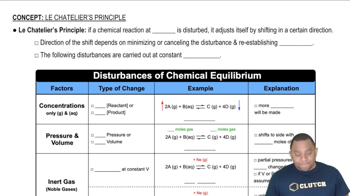
Understand the effect of adding an inert gas: Adding an inert gas at constant volume does not change the partial pressures of the reacting gases, as it does not participate in the reaction.
Apply Le Chatelier's Principle: Since the inert gas does not affect the partial pressures of A or B, the equilibrium position is not shifted by the addition of the inert gas.
Consider the number of moles: The total pressure increases, but the partial pressures of A and B remain unchanged, so the equilibrium concentrations of A and B remain the same.
Conclude: The number of A molecules in the equilibrium mixture will remain the same after adding an inert gas.

비슷한 문제에 대한 검증된 영상 답변:

이 영상 해법은 위 문제에 도움이 된다고 튜터들이 추천한 것입니다.
영상 길이:
1m

주요 개념

질문에 올바르게 답하기 위해 반드시 이해해야 하는 핵심 개념들은 다음과 같습니다.

Le Chatelier's Principle

Le Chatelier's Principle states that if a dynamic equilibrium is disturbed by changing the conditions, the position of equilibrium shifts to counteract the change. In the context of gaseous reactions, this principle helps predict how changes in pressure, temperature, or concentration will affect the equilibrium state.
추천 영상:
가이드 코스
07:32
Le Chatelier's Principle

Effect of Inert Gases on Equilibrium

Adding an inert gas at constant volume does not change the partial pressures of the reactants or products in a reaction at equilibrium. Since the inert gas does not participate in the reaction, it does not affect the equilibrium position directly, but it can influence the total pressure of the system.
추천 영상:
가이드 코스
02:31
Photoelectric Effect

Exothermic Reactions and Equilibrium

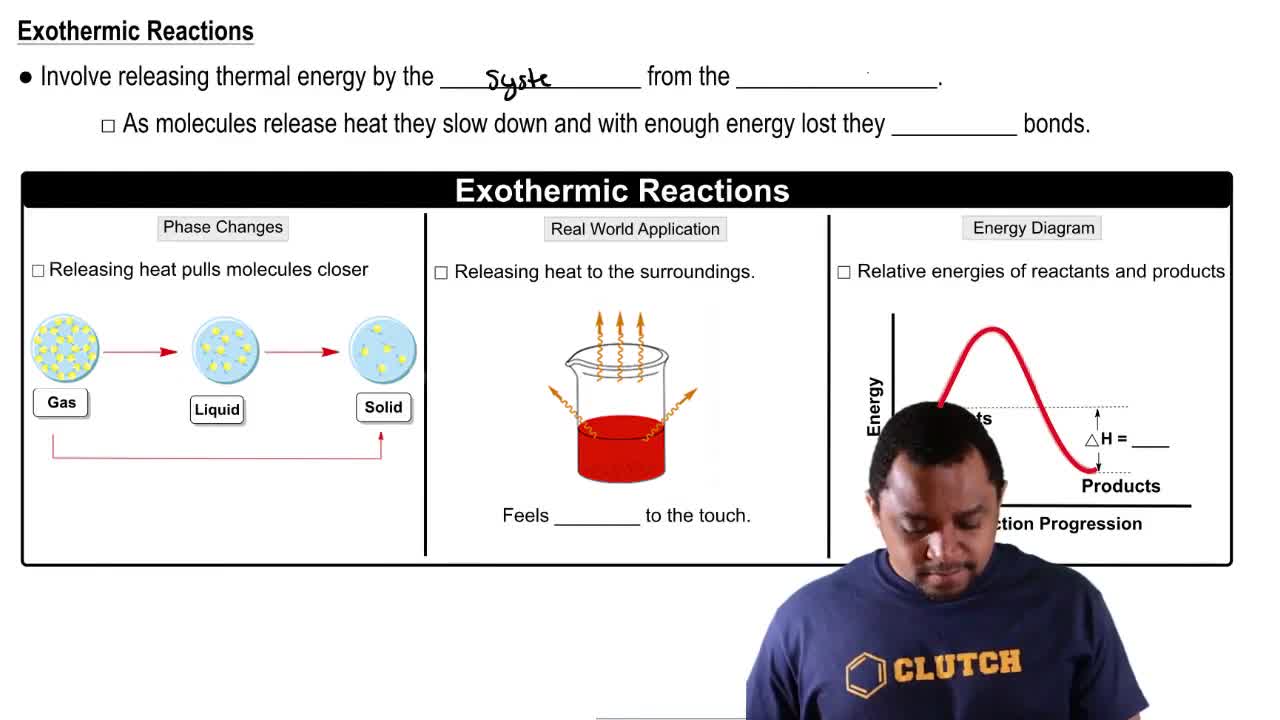
In exothermic reactions, heat is released as a product. When considering changes in temperature or pressure, the equilibrium will shift in a direction that either absorbs heat (endothermic) or releases heat (exothermic) to maintain balance. Understanding this helps predict how the equilibrium will respond to changes in conditions.
추천 영상:
가이드 코스
02:38
Endothermic & Exothermic Reactions
관련 실천
교과서 질문
The following pictures represent the composition of the equi- librium mixture for the reaction A + B ∆ AB at 300 K and at 400 K.

Is the reaction exothermic or endothermic? Explain using Le Châtelier's principle.
380
views

교과서 질문
Identify the true statement about the rate of the forward and reverse reaction once a reaction has reached equilibrium. (a) The rate of the forward reaction and the reverse reaction is zero. (b) The rate of the forward reaction is greater than the rate of the reverse reaction. (c) The rate of the reverse reaction is greater than the rate of the forward reaction. (d) The rate of the forward reaction is equal to the rate of the reverse reaction.
1104
views
교과서 질문

The following pictures represent the initial and equilibrium states for the exothermic decomposition of gaseous A mol- ecules (red) to give gaseous B molecules (blue). (a) Write a balanced chemical equation for the reaction.

682
views
교과서 질문

The following pictures represent the initial and equilibrium states for the exothermic reaction of solid A (red) with gas- eous B2 (blue) to give gaseous AB. (a) Write a balanced chemical equation for the reaction.

346
views
교과서 질문
The following picture represents the equilibrium state for the reaction 2 AB ∆ A2 + B2. Which rate constant is larger, kf or kr? Explain.
863
views
1
rank
교과서 질문
The following picture represents the composition of the equi- librium mixture for the endothermic reaction A2 ∆ 2 A at 500 K. Draw a picture that represents the equilibrium mixture after each of the following changes. (b) Increasing the volume

311
views