Ch.16 - Aqueous Equilibria: Acids & Bases
McMurry - Chemistry 8th Edition
McMurry8th EditionChemistryISBN: 9781292336145당신이 사용하는 게 아니라요?교과서 변경
16장, 문제 137

Arrange the following substances in order of increasing H3O+ concentration for a 0.10 M solution of each. (a) Zn(NO3)2 (b) Na2O (c) NaOCl (d) NaClO4 (e) HClO4

검증된 단계별 안내
1
Identify the nature of each substance: Determine if each substance is an acid, base, or neutral salt. This will help predict how they affect the H3O+ concentration in solution.
Consider the dissociation of each substance in water: Write the chemical equation for the dissociation of each compound in water to understand the ions produced.
Evaluate the effect on H3O+ concentration: For acids, consider how they increase H3O+ concentration. For bases, consider how they decrease H3O+ concentration by producing OH- ions. Neutral salts typically do not affect H3O+ concentration significantly.
Rank the substances: Based on the dissociation and the nature of each substance, arrange them in order of increasing H3O+ concentration.
Check for strong acids or bases: Identify if any of the substances are strong acids or bases, as they will have a more significant impact on the H3O+ concentration compared to weak acids or bases.

주요 개념

질문에 올바르게 답하기 위해 반드시 이해해야 하는 핵심 개념들은 다음과 같습니다.

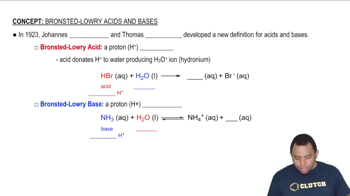
Acid-Base Theory

Acid-base theory explains how substances can donate or accept protons (H+ ions). Strong acids, like HClO4, completely dissociate in water, increasing H3O+ concentration significantly. In contrast, weak acids or neutral salts do not contribute to H3O+ concentration as effectively, making this theory essential for understanding the behavior of the given substances.
추천 영상:
가이드 코스
02:08
Bronsted-Lowry Acid-Base Theory

Dissociation of Ionic Compounds

Ionic compounds dissociate into their constituent ions when dissolved in water. For example, Zn(NO3)2 dissociates into Zn²+ and NO3- ions, while Na2O reacts with water to form Na+ and OH- ions. The extent of dissociation and the nature of the ions produced influence the resulting H3O+ concentration in the solution.
추천 영상:
가이드 코스
02:11
Ionic Compounds Naming

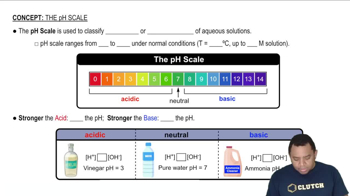
pH and H3O+ Concentration

The pH scale measures the acidity or basicity of a solution, with lower pH values indicating higher H3O+ concentrations. The relationship between pH and H3O+ is logarithmic, meaning that a small change in pH corresponds to a significant change in H3O+ concentration. Understanding this relationship is crucial for arranging the substances based on their H3O+ levels.
추천 영상: