Calculate the pH and the percent dissociation of the hydrated
cation in 0.020 M solutions of the following substances.
See Appendix C for values of equilibrium constants.
(a) Fe1NO322
검증된 단계별 안내
1
The compound given is Fe(NO3)2, which dissociates in water to form Fe^{2+} ions and NO3^- ions. The Fe^{2+} ion can further react with water to form a hydrated cation complex, typically represented as [Fe(H2O)6]^{2+}.
The hydrated cation [Fe(H2O)6]^{2+} can undergo hydrolysis, releasing H^+ ions and forming [Fe(H2O)5(OH)]^+. The equilibrium expression for this reaction is: [Fe(H2O)5(OH)]^+ + H^+.
Look up the equilibrium constant (K_a) for the hydrolysis of [Fe(H2O)6]^{2+} in Appendix C. This constant will help you set up the equilibrium expression: K_a = \(\frac{[Fe(H2O)5(OH)]^+[H^+]}{[Fe(H2O)6]^{2+}\)}.
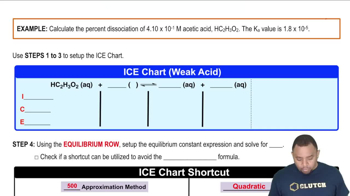
Use an ICE (Initial, Change, Equilibrium) table to determine the concentrations of the species at equilibrium. Start with the initial concentration of [Fe(H2O)6]^{2+} as 0.020 M, and assume initial concentrations of [Fe(H2O)5(OH)]^+ and H^+ are 0. Determine the changes in concentration as the system reaches equilibrium.
Use the equilibrium expression and the values from the ICE table to solve for the concentration of H^+ ions. Once you have [H^+], calculate the pH using the formula: pH = -\(\log\)[H^+]. To find the percent dissociation, use the formula: \(\text{Percent dissociation}\) = \(\left\)(\(\frac{[H^+]}{0.020}\)\(\right\)) \(\times\) 100%.>
비슷한 문제에 대한 검증된 영상 답변:
이 영상 해법은 위 문제에 도움이 된다고 튜터들이 추천한 것입니다.
영상 길이:
9m
영상 재생:
0 댓글
주요 개념
질문에 올바르게 답하기 위해 반드시 이해해야 하는 핵심 개념들은 다음과 같습니다.
pH Calculation
pH is a measure of the acidity or basicity of a solution, defined as the negative logarithm of the hydrogen ion concentration. To calculate pH, one must first determine the concentration of hydrogen ions in the solution, which can be derived from the dissociation of acids or the hydrolysis of cations in the case of salts. The formula used is pH = -log[H+].
Percent dissociation refers to the fraction of a substance that has dissociated into its ions in solution, expressed as a percentage. It is calculated using the formula: (amount dissociated / initial concentration) × 100%. This concept is crucial for understanding the strength of acids and bases, as well as the behavior of salts in solution.
Hydrated cations are positively charged ions that are surrounded by water molecules, which can affect their reactivity and the pH of the solution. The equilibrium constants, such as K_a for acids or K_b for bases, provide insight into the extent of dissociation or hydrolysis of these cations. For example, the stability of the hydrated iron cation (Fe^3+) can influence the pH and percent dissociation in the solution.


 검증된 단계별 안내
 02:15
02:15