Ch.16 - Aqueous Equilibria: Acids & Bases
McMurry - Chemistry 8th Edition
McMurry8th EditionChemistryISBN: 9781292336145당신이 사용하는 게 아니라요?교과서 변경
16장, 문제 84a

Calculate the pH of solutions prepared by: (a) Dissolving 4.8 g of lithium hydroxide in water to give 250 mL of solution.

검증된 단계별 안내
1
Calculate the number of moles of lithium hydroxide (LiOH) using its molar mass.
Determine the molarity of the LiOH solution by dividing the number of moles by the volume of the solution in liters.
Recognize that LiOH is a strong base and dissociates completely in water, so the concentration of OH⁻ ions is equal to the molarity of the LiOH solution.
Calculate the pOH of the solution using the formula \( \text{pOH} = -\log[\text{OH}^-] \).
Convert the pOH to pH using the relationship \( \text{pH} + \text{pOH} = 14 \).

비슷한 문제에 대한 검증된 영상 답변:

이 영상 해법은 위 문제에 도움이 된다고 튜터들이 추천한 것입니다.
영상 길이:
4m

주요 개념

질문에 올바르게 답하기 위해 반드시 이해해야 하는 핵심 개념들은 다음과 같습니다.

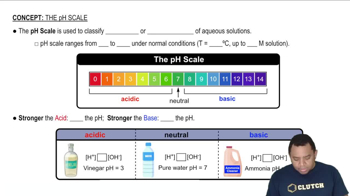
pH Scale

The pH scale measures the acidity or basicity of a solution, ranging from 0 to 14. A pH of 7 is neutral, values below 7 indicate acidity, and values above 7 indicate basicity. The scale is logarithmic, meaning each whole number change represents a tenfold change in hydrogen ion concentration.
추천 영상:

Strong Bases

Strong bases, like lithium hydroxide (LiOH), completely dissociate in water to produce hydroxide ions (OH-). This complete dissociation means that the concentration of hydroxide ions directly influences the pH of the solution, making it essential to calculate the concentration of LiOH to determine the resulting pH.
추천 영상:
가이드 코스
01:09
Strong Acid-Strong Base Titration

Concentration Calculations

To find the pH of a solution, it is crucial to calculate the molarity, which is the number of moles of solute per liter of solution. For lithium hydroxide, the mass of the solute is converted to moles using its molar mass, and then the volume of the solution is used to find the concentration, which is necessary for determining the pH.
추천 영상:
가이드 코스
07:35
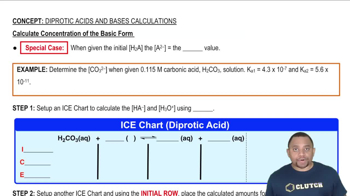
Calculate Concentration of the Basic Form