Ch.16 - Aqueous Equilibria: Acids & Bases
McMurry - Chemistry 8th Edition
McMurry8th EditionChemistryISBN: 9781292336145당신이 사용하는 게 아니라요?교과서 변경
16장, 문제 9

Determine the following concentrations for a 0.40 M H2Se solution that has the stepwise dissociation constants of Ka1 = 1.3 * 10^-4 and Ka2 = 1.0 * 10^-11. (LO 16.10) (a) [H2Se] = 0.35, [HSe^-] = 5.0 * 10^-2, [H3O^+] = 3.0 * 10^-3, [Se^2-] = 1.3 * 10^-4 (b) [H2Se] = 0.39, [HSe^-] = 7.2 * 10^-3, [H3O^+] = 7.2 * 10^-3, [Se^2-] = 1.0 * 10^-11 (c) [H2Se] = 0.31, [HSe^-] = 9.0 * 10^-2, [H3O^+] = 9.0 * 10^-2, [Se^2-] = 1.0 * 10^-11 (d) [H2Se] = 0.40, [HSe^-] = 1.3 * 10^-4, [H3O^+] = 1.3 * 10^-4, [Se^2-] = 1.0 * 10^-11


검증된 단계별 안내
1
Step 1: Understand the dissociation process of H2Se. It dissociates in two steps: H2Se ⇌ HSe^- + H^+ (first dissociation) and HSe^- ⇌ Se^2- + H^+ (second dissociation).
Step 2: Use the first dissociation constant (Ka1 = 1.3 * 10^-4) to set up the equilibrium expression: Ka1 = [HSe^-][H^+]/[H2Se]. Assume initial [H2Se] = 0.40 M and solve for [HSe^-] and [H^+].
Step 3: Use the second dissociation constant (Ka2 = 1.0 * 10^-11) to set up the equilibrium expression: Ka2 = [Se^2-][H^+]/[HSe^-]. Use the [HSe^-] and [H^+] from the first dissociation to solve for [Se^2-].
Step 4: Compare the calculated concentrations of [H2Se], [HSe^-], [H^+], and [Se^2-] with the given options (a, b, c, d) to determine which set of concentrations matches the calculated values.
Step 5: Verify that the calculated concentrations satisfy both equilibrium expressions and the initial conditions, ensuring the correct choice is consistent with the dissociation constants and initial concentration.

주요 개념

질문에 올바르게 답하기 위해 반드시 이해해야 하는 핵심 개념들은 다음과 같습니다.

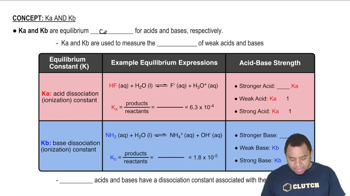
Dissociation Constants (Ka)

Dissociation constants (Ka) quantify the strength of an acid in solution, indicating how well it donates protons (H+) to water. For polyprotic acids like H2Se, there are multiple dissociation steps, each with its own Ka value. The first dissociation constant (Ka1) is typically larger than the second (Ka2), reflecting the decreasing tendency to lose additional protons as the acid becomes more negatively charged.
추천 영상:
가이드 코스
03:50
Characteristics of Ka and Kb

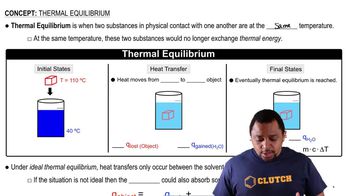
Equilibrium Concentrations

Equilibrium concentrations refer to the concentrations of reactants and products in a chemical reaction at equilibrium. In the context of acid dissociation, these concentrations can be determined using the initial concentration of the acid and the dissociation constants. The changes in concentration due to dissociation must be accounted for to find the equilibrium state, often using an ICE (Initial, Change, Equilibrium) table.
추천 영상:
가이드 코스
02:35
Thermal Equilibrium

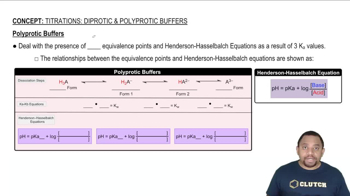
Polyprotic Acids

Polyprotic acids can donate more than one proton per molecule, undergoing multiple dissociation steps. Each step has its own dissociation constant, and the overall behavior of the acid in solution is influenced by these successive dissociations. Understanding the sequential nature of these reactions is crucial for calculating the concentrations of the various species present in solution, such as H2Se, HSe^-, and Se^2-.
추천 영상:
가이드 코스
03:25
Polyprotic Buffers