Ch.16 - Aqueous Equilibria: Acids & Bases
McMurry - Chemistry 8th Edition
McMurry8th EditionChemistryISBN: 9781292336145당신이 사용하는 게 아니라요?교과서 변경
16장, 문제 63b

Identify the weakest acid in each of the following sets. Explain your reasoning. (b) NH3, H2O, H2S

검증된 단계별 안내
1
Identify the molecular structures and properties of NH3 (ammonia), H2O (water), and H2S (hydrogen sulfide).
Understand that the strength of an acid is influenced by its ability to donate a proton (H+). The weaker the acid, the less readily it donates a proton.
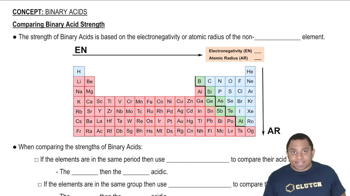
Compare the electronegativity and the stability of the conjugate bases formed after donating a proton. A more stable conjugate base corresponds to a stronger acid.
Analyze the basicity of the molecules. A stronger base typically indicates a weaker acid, as the molecule is more likely to accept a proton rather than donate one.
Conclude by comparing the basicity and the stability of the conjugate bases of NH3, H2O, and H2S to determine which is the weakest acid.

비슷한 문제에 대한 검증된 영상 답변:

이 영상 해법은 위 문제에 도움이 된다고 튜터들이 추천한 것입니다.
영상 길이:
5m

주요 개념

질문에 올바르게 답하기 위해 반드시 이해해야 하는 핵심 개념들은 다음과 같습니다.

Acid Strength

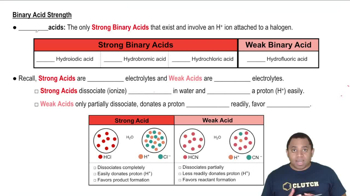
Acid strength refers to the ability of an acid to donate protons (H+) in a solution. Strong acids completely dissociate in water, while weak acids only partially dissociate. The strength of an acid is often measured by its acid dissociation constant (Ka), with larger Ka values indicating stronger acids.
추천 영상:
가이드 코스
03:51
Binary Acid Strengths

Conjugate Base Stability

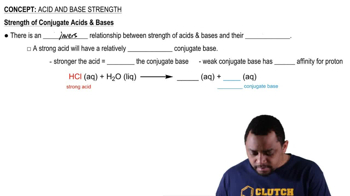
The stability of a conjugate base plays a crucial role in determining acid strength. A more stable conjugate base corresponds to a stronger acid because the equilibrium favors the formation of the conjugate base. Factors affecting stability include electronegativity, resonance, and the size of the atom bearing the negative charge.
추천 영상:
가이드 코스
00:50
Strength of Conjugate Acids and Bases

Comparative Analysis of Acids

To identify the weakest acid among a set, one must compare their tendencies to donate protons. This involves analyzing their structures and the resulting conjugate bases. For example, NH3 (ammonia) is a weak base and does not act as an acid, while H2O (water) and H2S (hydrogen sulfide) can donate protons, with H2O being the weakest acid due to its higher pKa value.
추천 영상:
가이드 코스
01:58
Comparing Binary Acid Strength