Ch.16 - Aqueous Equilibria: Acids & Bases
McMurry - Chemistry 8th Edition
McMurry8th EditionChemistryISBN: 9781292336145당신이 사용하는 게 아니라요?교과서 변경
16장, 문제 48

Which of the following are Brønsted–Lowry bases but not Arrhenius bases? (a) NH3 (b) HCO3-

검증된 단계별 안내
1
Step 1: Understand the definitions of Brønsted–Lowry and Arrhenius bases. A Brønsted–Lowry base is a substance that can accept a proton (H+), while an Arrhenius base is a substance that increases the concentration of OH- ions in aqueous solution.
Step 2: Analyze NH3 (ammonia). NH3 can accept a proton to form NH4+, making it a Brønsted–Lowry base. However, it does not directly produce OH- ions in solution, so it is not an Arrhenius base.
Step 3: Analyze HCO3- (bicarbonate ion). HCO3- can accept a proton to form H2CO3, making it a Brønsted–Lowry base. It can also react with water to produce OH- ions, so it can act as an Arrhenius base as well.
Step 4: Compare the two substances. NH3 is a Brønsted–Lowry base but not an Arrhenius base, while HCO3- can act as both.
Step 5: Conclude that NH3 is the substance that fits the criteria of being a Brønsted–Lowry base but not an Arrhenius base.

주요 개념

질문에 올바르게 답하기 위해 반드시 이해해야 하는 핵심 개념들은 다음과 같습니다.

Brønsted–Lowry Theory

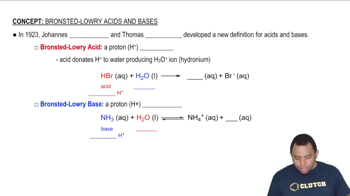
The Brønsted–Lowry theory defines acids as proton donors and bases as proton acceptors. This theory emphasizes the role of protons (H+) in acid-base reactions, allowing for a broader classification of substances as acids or bases based on their ability to donate or accept protons, regardless of their behavior in water.
추천 영상:
가이드 코스
02:08
Bronsted-Lowry Acid-Base Theory

Arrhenius Theory

The Arrhenius theory classifies acids as substances that increase the concentration of H+ ions in aqueous solution and bases as substances that increase the concentration of OH- ions. This definition is limited to aqueous solutions and does not account for acid-base reactions that occur in non-aqueous environments or those that do not produce hydroxide ions.
추천 영상:
가이드 코스
01:20
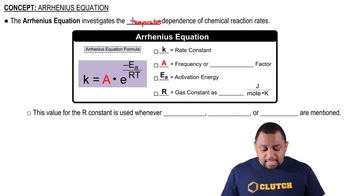
Arrhenius Equation

Amphoteric Species

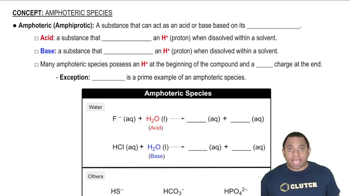
Amphoteric species are substances that can act as either an acid or a base depending on the context of the reaction. For example, bicarbonate (HCO3-) can accept a proton to act as a Brønsted–Lowry base or donate a proton to act as a Brønsted–Lowry acid, illustrating the versatility of certain species in acid-base chemistry.
추천 영상:
가이드 코스
03:03
Amphoteric Species