Write a balanced net ionic equation and the corresponding
equilibrium equation for the reaction of the following weak
bases with water.
(c) Cyanide ion, CN
검증된 단계별 안내
1
Step 1: Write the reaction of the cyanide ion with water. The cyanide ion (CN-) acts as a base and accepts a proton (H+) from water, which acts as an acid. This results in the formation of hydrocyanic acid (HCN) and hydroxide ion (OH-). The reaction is: CN- + H2O -> HCN + OH-
Step 2: Since cyanide ion is a weak base, it does not completely ionize in water. Therefore, the reaction is reversible and we can write the equilibrium expression for the reaction. The equilibrium constant for the reaction of a base with water is known as the base ionization constant (Kb).
Step 3: Write the equilibrium equation. The equilibrium equation is the ratio of the product of the concentrations of the products to the product of the concentrations of the reactants, each raised to the power of their stoichiometric coefficients. For the reaction, the equilibrium equation is: Kb = [HCN][OH-] / [CN-]
Step 4: Note that the concentration of water is not included in the equilibrium expression. This is because water is a pure liquid and its concentration remains essentially constant during the reaction.
Step 5: The balanced net ionic equation and the corresponding equilibrium equation for the reaction of cyanide ion with water are: CN- + H2O <=> HCN + OH- and Kb = [HCN][OH-] / [CN-]
비슷한 문제에 대한 검증된 영상 답변:
이 영상 해법은 위 문제에 도움이 된다고 튜터들이 추천한 것입니다.
영상 길이:
1m
영상 재생:
0 댓글
주요 개념
질문에 올바르게 답하기 위해 반드시 이해해야 하는 핵심 개념들은 다음과 같습니다.
Net Ionic Equations
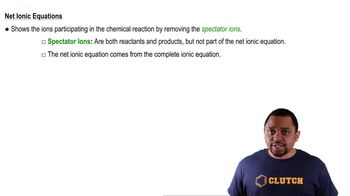
A net ionic equation represents the chemical species that are involved in a reaction, excluding spectator ions. It focuses on the actual chemical change occurring in the solution. For weak bases, the net ionic equation typically shows the base accepting a proton from water, resulting in the formation of hydroxide ions and the conjugate acid of the base.
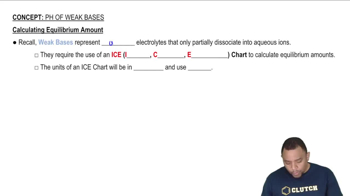
Weak bases are substances that partially dissociate in water to produce hydroxide ions (OH⁻) and their conjugate acids. Unlike strong bases, which completely dissociate, weak bases establish an equilibrium between the undissociated base and its ions in solution. Understanding the behavior of weak bases is crucial for writing accurate chemical equations.
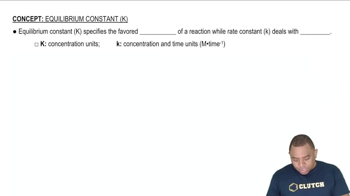
The equilibrium constant (K) quantifies the ratio of the concentrations of products to reactants at equilibrium for a reversible reaction. For weak bases, the equilibrium expression is derived from the dissociation of the base in water. This concept is essential for understanding the extent of the reaction and predicting the direction in which the reaction will proceed.


 검증된 단계별 안내
 00:51
00:51