Ch.17 - Applications of Aqueous Equilibria
McMurry - Chemistry 8th Edition
McMurry8th EditionChemistryISBN: 9781292336145당신이 사용하는 게 아니라요?교과서 변경
17장, 문제 133

Can Co2+ be separated from Zn2+ by bubbling H2S through a 0.3 M HCl solution that contains 0.01 M Co2+ and 0.011 M Zn2+? A saturated solution of H2S has [H2S] approximately equal to 0.10 M. Values of Ksp are 3 for CoS and 3 x 10^-2 for ZnS.

검증된 단계별 안내
1
Step 1: Write the solubility product expressions for CoS and ZnS. The solubility product constant (K_{sp}) for CoS is given as 3, and for ZnS, it is 3 \(\times\) 10^{-2}. The expressions are: K_{sp} = [Co^{2+}][S^{2-}] for CoS and K_{sp} = [Zn^{2+}][S^{2-}] for ZnS.
Step 2: Determine the concentration of sulfide ions ([S^{2-}]) required to precipitate each metal ion. For CoS, [S^{2-}] = \(\frac{K_{sp}\)}{[Co^{2+}]} = \(\frac{3}{0.01}\). For ZnS, [S^{2-}] = \(\frac{K_{sp}\)}{[Zn^{2+}]} = \(\frac{3 \times 10^{-2}\)}{0.011}.
Step 3: Compare the [S^{2-}] values calculated in Step 2. The metal ion that requires a lower concentration of [S^{2-}] will precipitate first. This comparison will help determine if Co^{2+} can be selectively precipitated from Zn^{2+}.
Step 4: Consider the effect of the acidic environment (0.3 M HCl) on the dissociation of H2S. In acidic solutions, the concentration of S^{2-} ions is reduced due to the equilibrium: H2S \(\rightleftharpoons\) 2H^+ + S^{2-}. Calculate the [S^{2-}] in the presence of 0.3 M HCl using the equilibrium expression for H2S.
Step 5: Evaluate if the [S^{2-}] in the acidic solution is sufficient to precipitate CoS but not ZnS. If the [S^{2-}] is greater than the value needed for CoS but less than that for ZnS, Co^{2+} can be separated from Zn^{2+} by bubbling H2S through the solution.

주요 개념

질문에 올바르게 답하기 위해 반드시 이해해야 하는 핵심 개념들은 다음과 같습니다.

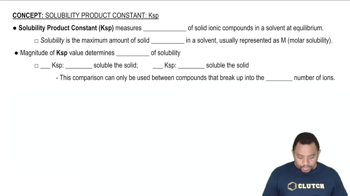
Solubility Product Constant (Ksp)

The solubility product constant (Ksp) is a numerical value that represents the equilibrium between a solid and its ions in a saturated solution. It is specific to a particular compound and is used to predict whether a precipitate will form when two solutions are mixed. For example, the Ksp values for CoS and ZnS indicate the concentrations of Co2+ and Zn2+ ions at which these sulfides will begin to precipitate out of solution.
추천 영상:
가이드 코스
01:47
Solubility Product Constant

Precipitation Reaction

A precipitation reaction occurs when two soluble salts react in solution to form an insoluble compound, or precipitate. In this case, bubbling H2S through the solution introduces sulfide ions, which can react with Co2+ and Zn2+ to form CoS and ZnS, respectively. The ability to separate Co2+ from Zn2+ depends on the relative solubility of their sulfides, as indicated by their Ksp values.
추천 영상:
가이드 코스
01:53
Selective Precipitation

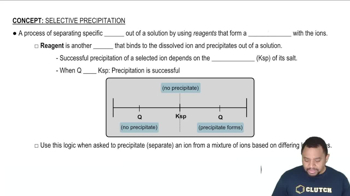
Selective Precipitation

Selective precipitation is a technique used to separate ions in a solution based on their differing solubility products. By controlling the concentration of sulfide ions through the addition of H2S, one can selectively precipitate one metal ion while leaving the other in solution. In this scenario, the Ksp values suggest that CoS will precipitate at a higher concentration of sulfide ions compared to ZnS, allowing for the potential separation of Co2+ from Zn2+.
추천 영상:
가이드 코스
01:53
Selective Precipitation