
Ch.17 - Applications of Aqueous Equilibria
McMurry - Chemistry 8th Edition
McMurry8th EditionChemistryISBN: 9781292336145당신이 사용하는 게 아니라요?교과서 변경
17장, 문제 159

Consider a galvanic cell that utilizes the following half-reactions: (d) Will AgCl precipitate if 10.0 mL of 0.200 M NaCl is added to the solution in part (c)? Will AgBr precipitate if 10.0 mL of 0.200 M KBr is added to the resulting solution?

검증된 단계별 안내
1
Identify the relevant solubility product constants (Ksp) for AgCl and AgBr from Appendix B.
Calculate the initial concentration of Cl^- ions when 10.0 mL of 0.200 M NaCl is added to the solution. Use the dilution formula: C1V1 = C2V2.
Determine the concentration of Ag^+ ions in the solution from part (c) before adding NaCl.
Calculate the ion product (Q) for AgCl using the concentrations of Ag^+ and Cl^- ions. Compare Q to Ksp to determine if AgCl will precipitate.
Repeat the process for AgBr by calculating the concentration of Br^- ions when 10.0 mL of 0.200 M KBr is added, then calculate the ion product (Q) for AgBr and compare it to its Ksp to determine if AgBr will precipitate.

비슷한 문제에 대한 검증된 영상 답변:

이 영상 해법은 위 문제에 도움이 된다고 튜터들이 추천한 것입니다.
영상 길이:
14m
도움이 되었나요?

주요 개념

질문에 올바르게 답하기 위해 반드시 이해해야 하는 핵심 개념들은 다음과 같습니다.

Precipitation Reactions

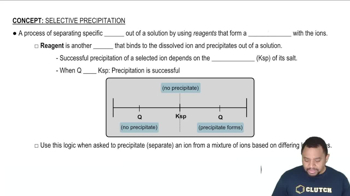
Precipitation reactions occur when two soluble salts react in solution to form an insoluble compound, known as a precipitate. The solubility product constant (Ksp) determines whether a precipitate will form based on the concentrations of the ions in solution. If the product of the ion concentrations exceeds the Ksp value, precipitation occurs.
추천 영상:
가이드 코스
01:53
Selective Precipitation

Solubility Product Constant (Ksp)

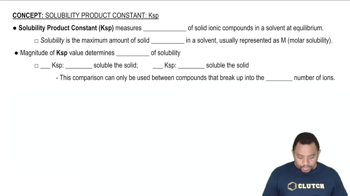
The solubility product constant (Ksp) is an equilibrium constant that quantifies the solubility of a sparingly soluble ionic compound. It is calculated from the concentrations of the ions in a saturated solution at a given temperature. For example, for AgCl, Ksp = [Ag+][Cl-], and if the product of these concentrations exceeds Ksp, AgCl will precipitate.
추천 영상:
가이드 코스
01:47
Solubility Product Constant

Dilution and Concentration Calculations

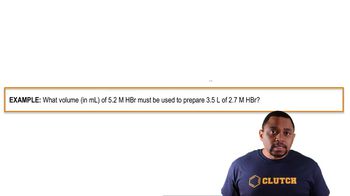
When solutions are mixed, the total volume increases, which affects the concentration of the ions present. The dilution formula (C1V1 = C2V2) can be used to calculate the new concentrations after mixing. Understanding how to calculate these concentrations is crucial for determining whether the conditions for precipitation are met after adding NaCl or KBr.
추천 영상:
가이드 코스
02:36
Dilution Calculation Example
관련 실천
교과서 질문
Some progressive hair coloring products marketed to men, such as Grecian Formula 16, contain lead acetate Pb(CH3CO2)2. As the coloring solution is rubbed on the hhair, the Pb2+ ions react with the sulfur atoms in hair proteins to give lead(II) sulfide (PbS), which is black. A typical coloring solution contains 0.3 mass% Pb(CH3CO2)2, and about 2 mL of the solution is used per application. (b) Suppose the hair is washed with shampoo and water that has pH = 5.50. How many washings would be required to remove 50% of the black color? Assume that 3 gal of water is used per washing and that the water becomes saturated with PbS. (c) Does the calculated number of washings look reason-able, given that frequent application of the coloring solution is recommended? What process(es) in addition to dissolution might contribute to the loss of color?
272
views
교과서 질문
Neutralization reactions involving either a strong acid or a strong base go essentially to completion, and therefore we must take such neutralizations into account before calculating concentrations in mixtures of acids and bases. Consider a mixture of 3.28 g of Na3PO4 and 300.0 mL of 0.180 M HCl. Write balanced net ionic equations for the neutralization reactions and calculate the pH of the solution.
514
views
교과서 질문

Some progressive hair coloring products marketed to men, such as Grecian Formula 16, contain lead acetate Pb(CH3CO2)2. As the coloring solution is rubbed on the hair, the Pb2+ ions react with the sulfur atoms in hair proteins to give lead(II) sulfide (PbS), which is black. A typical coloring solution contains 0.3 mass% Pb(CH3CO2)2, and about 2 mL of the solution is used per application. (a) Assuming that 30% of the Pb(CH3CO2)2 is converted to PbS, how many milligrams of PbS are formed per application of the coloring solution?

530
views