
Ch.17 - Applications of Aqueous Equilibria
McMurry - Chemistry 8th Edition
McMurry8th EditionChemistryISBN: 9781292336145당신이 사용하는 게 아니라요?교과서 변경
17장, 문제 4

What is the pH of a buffer solution prepared by dissolving 0.250 mol of NaH2PO4 and 0.075 mol of NaOH in enough water to make 1.00 L of solution? (Ka (H2PO4-) = 6.2 X 10^-8) (a) 6.32 (b) 6.83 (c) 7.21 (d) 7.71

검증된 단계별 안내
1
Identify the components of the buffer solution: NaH2PO4 (weak acid) and NaOH (strong base).
Determine the reaction between NaH2PO4 and NaOH: NaH2PO4 + NaOH -> Na2HPO4 + H2O.
Calculate the moles of Na2HPO4 formed and the remaining moles of NaH2PO4 after the reaction.
Use the Henderson-Hasselbalch equation: pH = pKa + log([A^-]/[HA]), where [A^-] is the concentration of Na2HPO4 and [HA] is the concentration of NaH2PO4.
Calculate the pH using the given Ka value to find pKa: pKa = -log(Ka).

비슷한 문제에 대한 검증된 영상 답변:

이 영상 해법은 위 문제에 도움이 된다고 튜터들이 추천한 것입니다.
영상 길이:
8m
도움이 되었나요?

주요 개념

질문에 올바르게 답하기 위해 반드시 이해해야 하는 핵심 개념들은 다음과 같습니다.

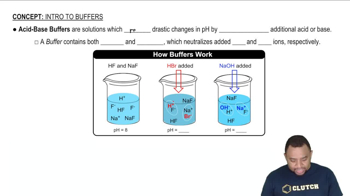
Buffer Solutions

A buffer solution is a system that resists changes in pH upon the addition of small amounts of acid or base. It typically consists of a weak acid and its conjugate base or a weak base and its conjugate acid. In this case, NaH2PO4 acts as the weak acid, while NaOH provides the conjugate base, H2PO4-. Understanding how buffers work is essential for calculating the pH of the solution.
추천 영상:
가이드 코스
03:02
Buffer Solutions

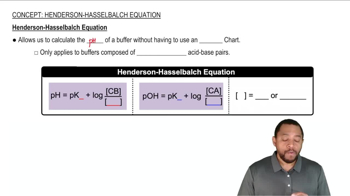
Henderson-Hasselbalch Equation

The Henderson-Hasselbalch equation is a mathematical formula used to calculate the pH of a buffer solution. It is expressed as pH = pKa + log([A-]/[HA]), where pKa is the negative logarithm of the acid dissociation constant (Ka), [A-] is the concentration of the conjugate base, and [HA] is the concentration of the weak acid. This equation is crucial for determining the pH of the buffer solution in the given problem.
추천 영상:
가이드 코스
02:40
Henderson-Hasselbalch Equation

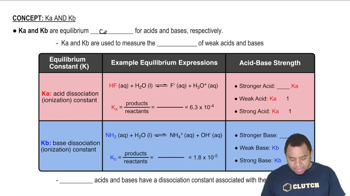
Acid Dissociation Constant (Ka)

The acid dissociation constant (Ka) quantifies the strength of an acid in solution, indicating how well it donates protons (H+) to the solution. A lower Ka value signifies a weaker acid. In this question, the provided Ka value for H2PO4- (6.2 x 10^-8) is necessary for calculating the pKa, which is used in the Henderson-Hasselbalch equation to find the pH of the buffer solution.
추천 영상:
가이드 코스
03:50
Characteristics of Ka and Kb