
Ch.17 - Applications of Aqueous Equilibria
McMurry - Chemistry 8th Edition
McMurry8th EditionChemistryISBN: 9781292336145당신이 사용하는 게 아니라요?교과서 변경
17장, 문제 146

When a typical diprotic acid H2A (Ka1 = 10^-4, Ka2 = 10^-10) is titrated with NaOH, the principal A-containing species at the first equivalence point is HA-. (b) Assuming that this is the principal reaction, show that the pH at the first equivalence point equals the average of pKa1 and pKa2. (c) How many A2- ions are present in 50.0 mL of 1.0 M NaHA?

검증된 단계별 안내
1
Step 1: Understand the concept of equivalence point in a titration. At the first equivalence point of a diprotic acid titration, all the initial H2A has been converted to HA-. This is because the amount of NaOH added is stoichiometrically equivalent to the amount of H2A initially present.
Step 2: Calculate the pKa values from the given Ka values. Use the formula \( \text{pKa} = -\log(\text{Ka}) \) to find pKa1 and pKa2. For Ka1 = 10^{-4}, pKa1 = 4. For Ka2 = 10^{-10}, pKa2 = 10.
Step 3: Determine the pH at the first equivalence point. At this point, the solution contains HA- ions, which can act as both an acid and a base. The pH is approximately the average of pKa1 and pKa2 because HA- is a weak acid and a weak base, and the solution is a buffer. Calculate the average: \( \text{pH} = \frac{\text{pKa1} + \text{pKa2}}{2} \).
Step 4: Calculate the number of A^{2-} ions in 50.0 mL of 1.0 M NaHA. First, determine the number of moles of NaHA: \( \text{moles of NaHA} = \text{volume (L)} \times \text{molarity} = 0.050 \times 1.0 \).
Step 5: Recognize that in a solution of NaHA, the HA- ions can dissociate to form A^{2-} ions. However, the extent of this dissociation is determined by the second dissociation constant, Ka2. Use the equilibrium expression for the dissociation of HA- to calculate the concentration of A^{2-} ions.

주요 개념

질문에 올바르게 답하기 위해 반드시 이해해야 하는 핵심 개념들은 다음과 같습니다.

Diprotic Acids and Their Ionization

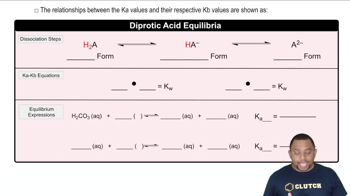
Diprotic acids can donate two protons (H+) in a stepwise manner, characterized by two dissociation constants, Ka1 and Ka2. The first ionization produces a conjugate base (HA-) and the second ionization produces A2-. Understanding these ionization steps is crucial for analyzing the behavior of diprotic acids during titration.
추천 영상:
가이드 코스
04:41
3 forms of Diprotic Acids

Equivalence Point in Titration

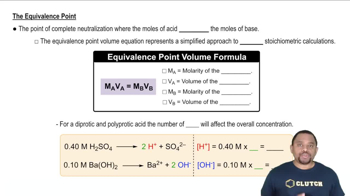
The equivalence point in a titration is reached when the amount of titrant added is stoichiometrically equivalent to the amount of analyte present. For diprotic acids, the first equivalence point occurs when half of the acid has been converted to its first conjugate base (HA-), which is essential for calculating pH and understanding the species present at this stage.
추천 영상:
가이드 코스
03:06
Equivalence Point in Titration

pH and pKa Relationship

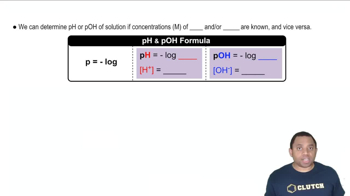
The pH at the equivalence point of a diprotic acid titration can be determined using the average of the pKa values of the acid. This relationship arises from the Henderson-Hasselbalch equation, which relates pH, pKa, and the ratio of the concentrations of the acid and its conjugate base, providing a way to predict the pH based on the acid's dissociation constants.
추천 영상:
가이드 코스
02:09
pH and pOH Calculations