Ch.18 - Thermodynamics: Entropy, Free Energy & Equilibrium
McMurry - Chemistry 8th Edition
McMurry8th EditionChemistryISBN: 9781292336145당신이 사용하는 게 아니라요?교과서 변경
18장, 문제 73

Elemental sulfur is formed by the reaction of zinc sulfide with oxygen: (b) At what temperature, if any, the reaction will become nonspontaneous?

검증된 단계별 안내
1
Identify the chemical reaction: \( \text{ZnS} + \text{O}_2 \rightarrow \text{ZnO} + \text{SO}_2 \).
Use the Gibbs free energy equation: \( \Delta G = \Delta H - T\Delta S \), where \( \Delta G \) is the change in Gibbs free energy, \( \Delta H \) is the change in enthalpy, \( T \) is the temperature in Kelvin, and \( \Delta S \) is the change in entropy.
Determine the \( \Delta H \) and \( \Delta S \) for the reaction using standard enthalpy and entropy values from a data table.
Set \( \Delta G = 0 \) to find the temperature at which the reaction becomes nonspontaneous, and solve for \( T \) using the equation \( T = \frac{\Delta H}{\Delta S} \).
Ensure the units are consistent (e.g., convert \( \Delta H \) from kJ to J if necessary) and solve for \( T \) to find the temperature at which the reaction becomes nonspontaneous.

비슷한 문제에 대한 검증된 영상 답변:

이 영상 해법은 위 문제에 도움이 된다고 튜터들이 추천한 것입니다.
영상 길이:
4m

주요 개념

질문에 올바르게 답하기 위해 반드시 이해해야 하는 핵심 개념들은 다음과 같습니다.

Gibbs Free Energy

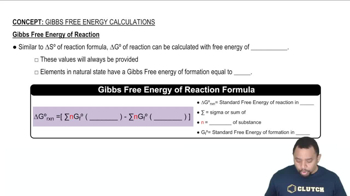
Gibbs Free Energy (G) is a thermodynamic potential that helps predict the spontaneity of a reaction. A reaction is spontaneous when the change in Gibbs Free Energy (ΔG) is negative. The relationship between enthalpy (ΔH), entropy (ΔS), and temperature (T) is given by the equation ΔG = ΔH - TΔS, where T is in Kelvin. Understanding this concept is crucial for determining the conditions under which a reaction becomes nonspontaneous.
추천 영상:
가이드 코스
01:51
Gibbs Free Energy of Reactions

Spontaneity and Temperature

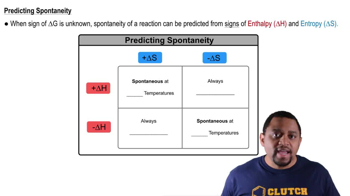
The spontaneity of a reaction can depend on temperature, particularly when the enthalpy and entropy changes are of different signs. For example, if a reaction is exothermic (ΔH < 0) and has an increase in entropy (ΔS > 0), it will generally be spontaneous at all temperatures. Conversely, if ΔH > 0 and ΔS < 0, the reaction will be nonspontaneous at all temperatures. Identifying the temperature at which spontaneity changes requires analyzing these thermodynamic parameters.
추천 영상:
가이드 코스
01:17
Spontaneity and Temperature

Phase Changes and Reaction Conditions

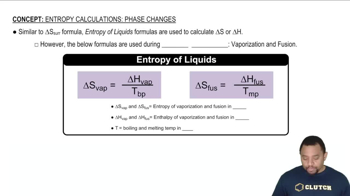
The conditions under which a reaction occurs, including temperature and pressure, can significantly influence the products formed and their stability. In the case of the reaction between zinc sulfide and oxygen, the temperature can affect the equilibrium position and the Gibbs Free Energy. Understanding how phase changes and reaction conditions impact the formation of products like elemental sulfur is essential for predicting when the reaction will become nonspontaneous.
추천 영상:
가이드 코스
01:46
Entropy in Phase Changes