Ch.18 - Thermodynamics: Entropy, Free Energy & Equilibrium
McMurry - Chemistry 8th Edition
McMurry8th EditionChemistryISBN: 9781292336145당신이 사용하는 게 아니라요?교과서 변경
18장, 문제 102

Ethanol is manufactured in industry by the hydration of ethylene: Using the data in Appendix B, calculate ∆G° and show that this reaction is spontaneous at 25 °C. Why does this reaction become nonspontaneous at higher temperatures? Estimate the temperature at which the reaction becomes nonspontaneous.

검증된 단계별 안내
1
Identify the chemical reaction: Ethylene (C_2H_4) reacts with water (H_2O) to form ethanol (C_2H_5OH).
Use the standard Gibbs free energy of formation (∆G_f°) values from Appendix B for each substance involved in the reaction to calculate the standard Gibbs free energy change (∆G°) for the reaction: ∆G° = Σ∆G_f°(products) - Σ∆G_f°(reactants).
Determine if the reaction is spontaneous at 25 °C by checking if ∆G° is negative. A negative ∆G° indicates a spontaneous reaction.
Understand that the spontaneity of a reaction depends on both enthalpy (∆H°) and entropy (∆S°) changes, using the equation ∆G° = ∆H° - T∆S°. At higher temperatures, the T∆S° term can become significant enough to make ∆G° positive, indicating nonspontaneity.
Estimate the temperature at which the reaction becomes nonspontaneous by setting ∆G° = 0 and solving for T: T = ∆H°/∆S°. Use the values of ∆H° and ∆S° from Appendix B.

비슷한 문제에 대한 검증된 영상 답변:

이 영상 해법은 위 문제에 도움이 된다고 튜터들이 추천한 것입니다.
영상 길이:
7m
도움이 되었나요?

주요 개념

질문에 올바르게 답하기 위해 반드시 이해해야 하는 핵심 개념들은 다음과 같습니다.

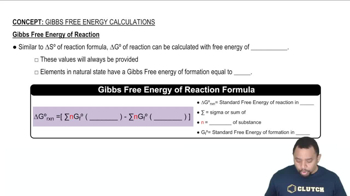
Gibbs Free Energy (∆G°)

Gibbs Free Energy (∆G°) is a thermodynamic potential that measures the maximum reversible work obtainable from a thermodynamic process at constant temperature and pressure. A negative ∆G° indicates that a reaction is spontaneous, while a positive ∆G° suggests nonspontaneity. The relationship between enthalpy, entropy, and temperature is crucial in determining the spontaneity of a reaction.
추천 영상:
가이드 코스
01:51
Gibbs Free Energy of Reactions

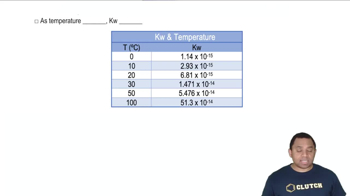
Spontaneity and Temperature Dependence

The spontaneity of a reaction can depend on temperature due to the interplay between enthalpy (∆H) and entropy (∆S). The Gibbs Free Energy equation, ∆G = ∆H - T∆S, shows that as temperature increases, the T∆S term becomes more significant. If the entropy change is positive, higher temperatures can favor spontaneity, while a negative entropy change can lead to nonspontaneity at elevated temperatures.
추천 영상:
가이드 코스
01:24
Kw Temperature Dependence

Calculating Temperature for Nonspontaneity

To estimate the temperature at which a reaction becomes nonspontaneous, one can set ∆G to zero in the Gibbs Free Energy equation, leading to the equation T = ∆H/∆S. This calculation provides the threshold temperature where the balance between enthalpy and entropy shifts, indicating the point at which the reaction transitions from spontaneous to nonspontaneous.
추천 영상:
가이드 코스
03:48
Temperature vs Heat