Ch.18 - Thermodynamics: Entropy, Free Energy & Equilibrium
McMurry - Chemistry 8th Edition
McMurry8th EditionChemistryISBN: 9781292336145당신이 사용하는 게 아니라요?교과서 변경
18장, 문제 86

Given the data in Problem 18.78, calculate ∆G for the vaporization of benzene at: (a) 70 °C Predict whether benzene will boil at each of these temperatures and 1 atm pressure.

검증된 단계별 안내
1
Identify the given data from Problem 18.78, which should include the enthalpy of vaporization (\( \Delta H_{vap} \)) and the entropy of vaporization (\( \Delta S_{vap} \)) for benzene.
Use the Gibbs free energy equation for vaporization: \( \Delta G = \Delta H_{vap} - T \Delta S_{vap} \), where \( T \) is the temperature in Kelvin.
Convert the given temperature from Celsius to Kelvin by adding 273.15 to the Celsius temperature (70 °C + 273.15 = 343.15 K).
Substitute the values of \( \Delta H_{vap} \), \( T \), and \( \Delta S_{vap} \) into the Gibbs free energy equation to calculate \( \Delta G \).
Determine if benzene will boil at 70 °C and 1 atm by checking if \( \Delta G \) is less than or equal to zero, which indicates that the vaporization process is spontaneous.

비슷한 문제에 대한 검증된 영상 답변:

이 영상 해법은 위 문제에 도움이 된다고 튜터들이 추천한 것입니다.
영상 길이:
2m

주요 개념

질문에 올바르게 답하기 위해 반드시 이해해야 하는 핵심 개념들은 다음과 같습니다.

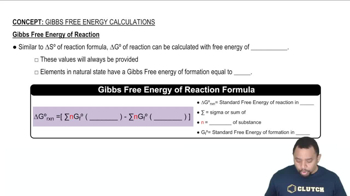
Gibbs Free Energy (∆G)

Gibbs Free Energy (∆G) is a thermodynamic potential that measures the maximum reversible work obtainable from a thermodynamic system at constant temperature and pressure. It is crucial for predicting the spontaneity of a process; a negative ∆G indicates a spontaneous reaction, while a positive ∆G suggests non-spontaneity. In the context of vaporization, calculating ∆G helps determine whether the phase change from liquid to gas is favorable under given conditions.
추천 영상:
가이드 코스
01:51
Gibbs Free Energy of Reactions

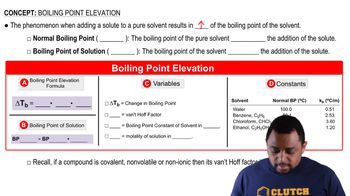
Vaporization and Boiling Point

Vaporization is the process by which a liquid turns into vapor, and the boiling point is the temperature at which this occurs at a specific pressure. For a substance to boil, its vapor pressure must equal the external pressure. Understanding the relationship between temperature, pressure, and vapor pressure is essential for predicting whether a liquid will boil at a given temperature and pressure, such as 1 atm.
추천 영상:
가이드 코스
03:05
Boiling Point Elevation

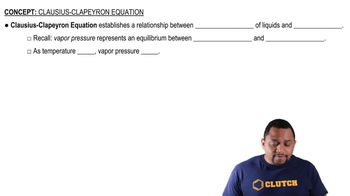
Clausius-Clapeyron Equation

The Clausius-Clapeyron equation describes the relationship between the vapor pressure of a substance and its temperature, providing a way to calculate changes in vapor pressure with temperature. This equation is particularly useful for determining the boiling point of a liquid at different pressures and for calculating ∆G for phase transitions. It highlights how temperature influences the equilibrium between phases, which is critical for understanding the boiling behavior of substances like benzene.
추천 영상:
가이드 코스
00:59
Clausius-Clapeyron Equation