Ch.18 - Thermodynamics: Entropy, Free Energy & Equilibrium
McMurry - Chemistry 8th Edition
McMurry8th EditionChemistryISBN: 9781292336145당신이 사용하는 게 아니라요?교과서 변경
18장, 문제 125

Is it possible for a reaction to be nonspontaneous yet exo-thermic? Explain.

검증된 단계별 안내
1
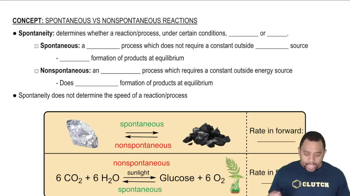
Understand the terms: A reaction is exothermic if it releases heat, meaning the enthalpy change (ΔH) is negative. A reaction is nonspontaneous if it does not occur on its own without external input, which is determined by the Gibbs free energy change (ΔG).
Recall the Gibbs free energy equation: ΔG = ΔH - TΔS, where ΔG is the change in Gibbs free energy, ΔH is the change in enthalpy, T is the temperature in Kelvin, and ΔS is the change in entropy.
Consider the conditions for spontaneity: A reaction is spontaneous if ΔG is negative. If ΔG is positive, the reaction is nonspontaneous.
Analyze the scenario: For a reaction to be exothermic (ΔH < 0) and nonspontaneous (ΔG > 0), the term TΔS must be positive and larger in magnitude than ΔH, meaning the entropy change (ΔS) is positive and significant enough to make ΔG positive.
Conclude: Yes, it is possible for a reaction to be nonspontaneous yet exothermic if the increase in entropy (ΔS) is large enough to make the TΔS term outweigh the negative ΔH, resulting in a positive ΔG.

비슷한 문제에 대한 검증된 영상 답변:

이 영상 해법은 위 문제에 도움이 된다고 튜터들이 추천한 것입니다.
영상 길이:
1m

주요 개념

질문에 올바르게 답하기 위해 반드시 이해해야 하는 핵심 개념들은 다음과 같습니다.

Spontaneity of Reactions

Spontaneity refers to whether a reaction occurs naturally under given conditions without external influence. A spontaneous reaction has a negative Gibbs free energy change (ΔG < 0). However, spontaneity is not solely determined by enthalpy (heat content) but also by entropy (disorder), which can lead to nonspontaneous reactions even if they release heat.
추천 영상:
가이드 코스
04:20
Spontaneity of Processes

Exothermic Reactions

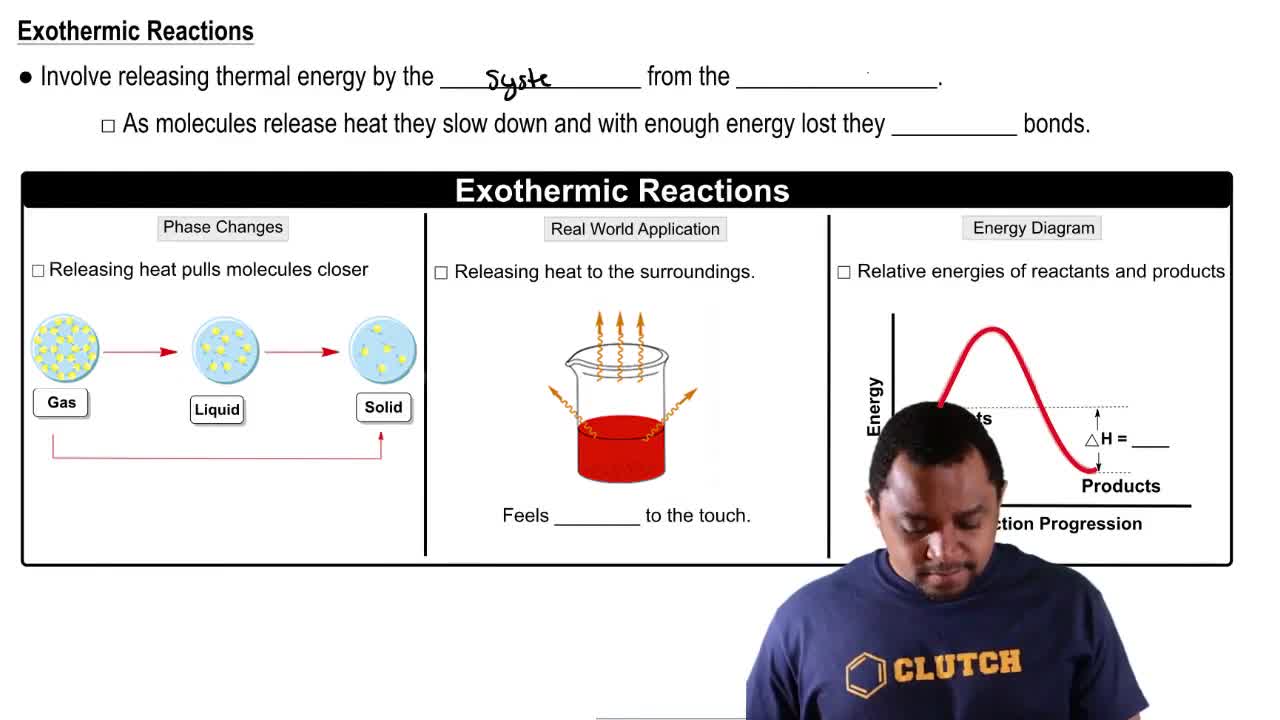
Exothermic reactions are those that release heat to the surroundings, resulting in a negative change in enthalpy (ΔH < 0). While these reactions often favor spontaneity, they can still be nonspontaneous if the increase in entropy is insufficient to overcome the energy barrier, particularly at lower temperatures or under specific conditions.
추천 영상:
가이드 코스
02:38
Endothermic & Exothermic Reactions

Gibbs Free Energy

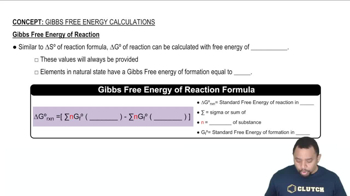
Gibbs free energy (G) combines enthalpy and entropy to determine the spontaneity of a reaction. The equation ΔG = ΔH - TΔS shows that a reaction can be exothermic (ΔH < 0) but still have a positive ΔG if the entropy change (ΔS) is negative or not large enough to offset the enthalpy term, resulting in a nonspontaneous process.
추천 영상:
가이드 코스
01:51
Gibbs Free Energy of Reactions
관련 실천
교과서 질문

Consider the Haber synthesis of gaseous NH3 (∆H°f = -46.1 kJ/mol; ∆G°f = -16.5 kJ/mol: (d) What are the equilibrium constants Kp and Kc for the reaction at 350 K? Assume that ∆H° and ∆S° are independent of temperature.

490
views

교과서 질문

Trouton's rule says that the ratio of the molar heat of vaporization of a liquid to its normal boiling point (in kelvin) is approximately the same for all liquids: ∆Hvap/Tbp ≈ 88 J/(K*mol) (b) Explain why liquids tend to have the same value of ∆Hvap/Tbp.

808
views
교과서 질문
Ammonium nitrate is dangerous because it decomposes (sometimes explosively) when heated: (a) Using the data in Appendix B, show that this reaction is spontaneous at 25 °C.
334
views
교과서 질문

Use the data in Appendix B to calculate the equilibrium pressure of CO2 in a closed 1 L vessel that contains each of the following samples:

(a) 15 g of MgCO3 and 1.0 g of MgO at 25 °C

(b) 15 g of MgCO3 and 1.0 g of MgO at 280 °C .

Assume that ∆H° and ∆S° are independent of temperature.

308
views
교과서 질문

Trouton's rule says that the ratio of the molar heat of vaporization of a liquid to its normal boiling point (in kelvin) is approximately the same for all liquids: ∆Hvap/Tbp ≈ 88 J/(K*mol) (a) Check the reliability of Trouton's rule for the liquids listed in the following table.

296
views
교과서 질문
The normal boiling point of bromine is 58.8 °C, and the standard entropies of the liquid and vapor are S°[Br2(l) = 152.2 J/(K*mol); S°[Br2(g) = 245.4 J/(K*mol). At what temperature does bromine have a vapor pressure of 227 mmHg?
1900
views