Consider the unbalanced equation: I2(s) → I-(aq) + IO3-(aq) (d) What pH is required for the reaction to be at equilibrium at 25°C when [I-] = 0.10M and [IO3-] = 0.50 M?
Ch.18 - Thermodynamics: Entropy, Free Energy & Equilibrium
18장, 문제 143m
Methanol (CH3OH) is made industrially in two steps from CO and H2. It is so cheap to make that it is being considered for use as a precursor to hydrocarbon fuels, such as methane (CH4):
Step 1. CO(g) + 2 H2(g) S CH3OH(l) ΔS° = - 332 J/K
Step 2. CH3OH1l2 → CH4(g) + 1/2 O2(g) ΔS° = 162 J/K
(m) If you were designing a production facility, would you plan on carrying out the reactions in separate steps or together? Explain.
검증된 단계별 안내1

비슷한 문제에 대한 검증된 영상 답변:
이 영상 해법은 위 문제에 도움이 된다고 튜터들이 추천한 것입니다.
영상 길이:
2m주요 개념
질문에 올바르게 답하기 위해 반드시 이해해야 하는 핵심 개념들은 다음과 같습니다.
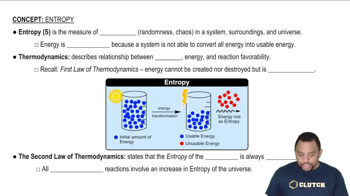
Thermodynamics and Entropy
Thermodynamics is the study of energy transformations, and entropy (ΔS) is a measure of disorder in a system. In the context of chemical reactions, a negative ΔS indicates that the reaction leads to a decrease in disorder, while a positive ΔS suggests an increase. Understanding the entropy changes in the given reactions is crucial for predicting the feasibility and spontaneity of the processes involved in methanol and methane production.
추천 영상:
가이드 코스
Entropy in Thermodynamics
Reaction Mechanism
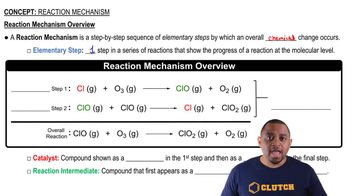
A reaction mechanism outlines the step-by-step sequence of elementary reactions that lead to the overall chemical transformation. In this case, the production of methanol from CO and H2 occurs in two distinct steps. Analyzing whether to carry out these reactions separately or together requires understanding how the intermediate products behave and how they influence the overall efficiency and yield of the desired products.
추천 영상:
가이드 코스
Reaction Mechanism Overview
Industrial Process Design
Industrial process design involves optimizing chemical reactions for large-scale production, considering factors like cost, efficiency, and safety. When deciding whether to conduct reactions in separate steps or in a continuous process, one must evaluate the energy requirements, potential for side reactions, and the economic implications of each approach. This decision impacts the overall productivity and sustainability of the methanol-to-methane conversion process.
추천 영상:
가이드 코스
Spontaneity of Processes
관련 실천
교과서 질문
317
views
교과서 질문
Methanol (CH3OH) is made industrially in two steps from CO and H2. It is so cheap to make that it is being considered for use as a precursor to hydrocarbon fuels, such as methane (CH4):
Step 1. CO(g) + 2 H2(g) S CH3OH(l) ΔS° = - 332 J/K
Step 2. CH3OH1l2 → CH4(g) + 1/2 O2(g) ΔS° = 162 J/K
(k) Calculate an overall ΔG°, ΔH°, and ΔS° for the formation of CH4 from CO and H2.
365
views
교과서 질문
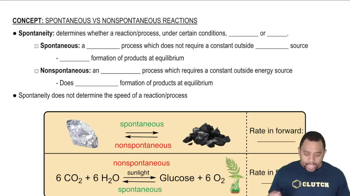
For a process to be spontaneous, the total entropy of the system and its surroundings must increase; that is
ΔStotal = ΔSsystem + ΔSsurr 7 0 for a spontaneous process
Furthermore, the entropy change in the surroundings, ΔSsurr, is related to the enthalpy change for the process by the equa- tion ΔSsurr = - ΔH>T.
(b) What is the value of ΔSsurr for the photosynthesis of glu- cose from CO2 at 298 K?
6 CO21g2 + 6 H2O1l2 S C6H12O61s2 + 6 O21g2
ΔG° = 2879 kJ
ΔS° = - 262 J>K
1557
views
교과서 질문
Methanol (CH3OH) is made industrially in two steps from CO and H2. It is so cheap to make that it is being considered for use as a precursor to hydrocarbon fuels, such as methane (CH4):
Step 1. CO(g) + 2 H2(g) S CH3OH(l) ΔS° = - 332 J/K
Step 2. CH3OH1l2 → CH4(g) + 1/2 O2(g) ΔS° = 162 J/K
(l) Is the overall reaction spontaneous at 298 K?
278
views