Ch.18 - Thermodynamics: Entropy, Free Energy & Equilibrium
McMurry - Chemistry 8th Edition
McMurry8th EditionChemistryISBN: 9781292336145당신이 사용하는 게 아니라요?교과서 변경
18장, 문제 134

Suppose that a reaction has ΔH = - 33 kJ and ΔS = - 58 J>K. At what temperature will it change from spontaneous to nonspontaneous?

검증된 단계별 안내
1
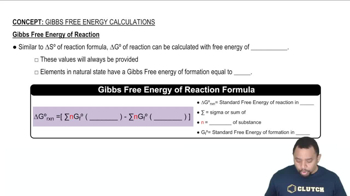
Identify the Gibbs free energy equation: \( \Delta G = \Delta H - T \Delta S \).
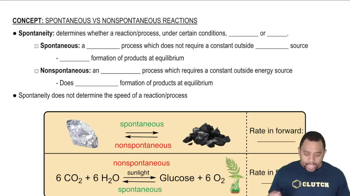
Recognize that a reaction is spontaneous when \( \Delta G < 0 \) and nonspontaneous when \( \Delta G > 0 \). The transition point is when \( \Delta G = 0 \).
Set \( \Delta G = 0 \) and substitute the given values into the equation: \( 0 = -33 \text{ kJ} - T(-58 \text{ J/K}) \).
Convert \( \Delta H \) from kJ to J to match the units of \( \Delta S \): \( -33 \text{ kJ} = -33000 \text{ J} \).
Solve for the temperature \( T \) by rearranging the equation: \( T = \frac{-33000 \text{ J}}{-58 \text{ J/K}} \).

비슷한 문제에 대한 검증된 영상 답변:

이 영상 해법은 위 문제에 도움이 된다고 튜터들이 추천한 것입니다.
영상 길이:
1m

주요 개념

질문에 올바르게 답하기 위해 반드시 이해해야 하는 핵심 개념들은 다음과 같습니다.

Gibbs Free Energy

Gibbs Free Energy (G) is a thermodynamic potential that helps predict the spontaneity of a reaction. It is defined by the equation ΔG = ΔH - TΔS, where ΔG is the change in Gibbs Free Energy, ΔH is the change in enthalpy, T is the temperature in Kelvin, and ΔS is the change in entropy. A reaction is spontaneous when ΔG is negative.
추천 영상:
가이드 코스
01:51
Gibbs Free Energy of Reactions

Spontaneity of Reactions

The spontaneity of a reaction refers to its ability to occur without external intervention. A reaction is spontaneous at a given temperature if the Gibbs Free Energy change (ΔG) is negative. The relationship between enthalpy (ΔH), entropy (ΔS), and temperature (T) determines whether a reaction will be spontaneous or nonspontaneous.
추천 영상:
가이드 코스
04:20
Spontaneity of Processes

Temperature and Entropy

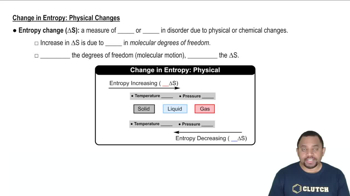
Temperature plays a crucial role in determining the spontaneity of a reaction, particularly when considering entropy changes. The term TΔS in the Gibbs Free Energy equation indicates that as temperature increases, the impact of entropy on spontaneity becomes more significant. If ΔS is negative, increasing temperature can lead to a positive ΔG, making the reaction nonspontaneous.
추천 영상:
가이드 코스
02:35
Entropy and Physical Changes
관련 실천
교과서 질문

The lead storage battery uses the reaction: (b) Calculate ∆G for this reaction on a cold winter's day (10 °F) in a battery that has run down to the point where the sulfuric acid concentration is only 0.100 M.

366
views

교과서 질문
Tell whether reactions with the following values of ΔH and ΔS are spontaneous or nonspontaneous and whether they are exothermic or endothermic. (a) ΔH = - 48 kJ; ΔS = + 135 J>K at 400 K (b) ΔH = - 48 kJ; ΔS = - 135 J>K at 400 K (c) ΔH = + 48 kJ; ΔS = + 135 J>K at 400 K (d) ΔH = + 48 kJ; ΔS = - 135 J>K at 400 K
520
views
교과서 질문
A mixture of 14.0 g of N2 and 3.024 g of H2 in a 5.00 L container is heated to 400 °C. Use the data in Appendix B to calculate the molar concentrations of N2, H2, and NH3 at equilibrium. Assume that ∆H° and ∆S° are independent of temperature, and remember that the standard state of a gas is defined in terms of pressure.

553
views
교과서 질문
Chloroform has ΔHvaporization = 29.2 kJ>mol and boils at 61.2 °C. What is the value of ΔSvaporization for chloroform?
770
views
교과서 질문
The following reaction, sometimes used in the laboratory to generate small quantities of oxygen gas, has ∆G° = -224.4 kJ/mol at 25°C:

Use the following additional data at 25 °C to calculate the standard molar entropy S° of O2 at 25°C: ∆H°f(KClO3) = -397.7 kJ/mol, ∆H°f(KCl) = -436.5 kJ/mol, S°(KClO3) = 143.1 J/(K*mol), and S°(KCl) = 82.6 J/(K*mol).
549
views
교과서 질문
The normal boiling point of bromine is 58.8 °C, and the standard entropies of the liquid and vapor are S°[Br2(l) = 152.2 J/(K*mol); S°[Br2(g) = 245.4 J/(K*mol). At what temperature does bromine have a vapor pressure of 227 mmHg?
1900
views