Use the data in Appendix B to calculate ∆G for the decom-position of nitrosyl chloride at 25 °C when the partial pressures are 2.00 atm of NOCl, 1.00 * 10^-3 atm of NO, and 1.00 * 10^-3 atm of Cl2: Is the reaction spontaneous in the forward or the reverse direction under these conditions?
검증된 단계별 안내
1
Identify the balanced chemical equation for the decomposition of nitrosyl chloride: 2 NOCl(g) \(\rightarrow\) 2 NO(g) + Cl_2(g).
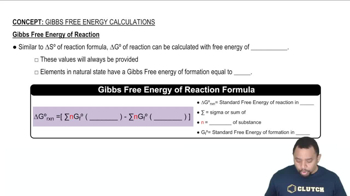
Use the standard Gibbs free energy of formation values (\( \Delta G_f^\circ \)) from Appendix B to calculate the standard Gibbs free energy change (\( \Delta G^\circ \)) for the reaction: \( \Delta G^\circ = \sum \Delta G_f^\circ (\text{products}) - \sum \Delta G_f^\circ (\text{reactants}) \).
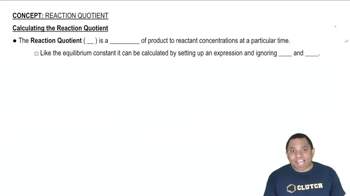
Calculate the reaction quotient \( Q \) using the given partial pressures: \( Q = \frac{(P_{NO})^2 (P_{Cl_2})}{(P_{NOCl})^2} \).
Apply the equation \( \Delta G = \Delta G^\circ + RT \ln Q \) to find the Gibbs free energy change under the given conditions, where \( R \) is the gas constant (8.314 J/mol·K) and \( T \) is the temperature in Kelvin.
Determine the spontaneity of the reaction by analyzing the sign of \( \Delta G \): if \( \Delta G < 0 \), the reaction is spontaneous in the forward direction; if \( \Delta G > 0 \), it is spontaneous in the reverse direction.
비슷한 문제에 대한 검증된 영상 답변:
이 영상 해법은 위 문제에 도움이 된다고 튜터들이 추천한 것입니다.
영상 길이:
3m
영상 재생:
0 댓글
주요 개념
질문에 올바르게 답하기 위해 반드시 이해해야 하는 핵심 개념들은 다음과 같습니다.
Gibbs Free Energy (∆G)
Gibbs Free Energy (∆G) is a thermodynamic potential that measures the maximum reversible work obtainable from a thermodynamic system at constant temperature and pressure. It is used to predict the spontaneity of a reaction: if ∆G is negative, the reaction is spontaneous in the forward direction; if positive, it is spontaneous in the reverse direction.
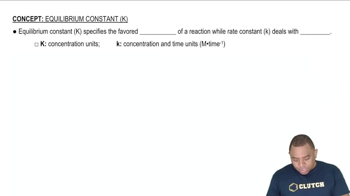
The equilibrium constant (K) is a dimensionless value that expresses the ratio of the concentrations of products to reactants at equilibrium for a given reaction at a specific temperature. It is related to Gibbs Free Energy by the equation ∆G = ∆G° + RT ln(Q), where Q is the reaction quotient. Understanding K helps determine the direction of spontaneity based on the current conditions.
The reaction quotient (Q) is a measure of the relative amounts of products and reactants present in a reaction at any point in time, calculated using the same expression as K but with current concentrations or partial pressures. Comparing Q to K allows us to predict the direction in which a reaction will proceed to reach equilibrium, indicating whether the forward or reverse reaction is favored.


 검증된 단계별 안내
 01:51
01:51