
Ch.19 - Electrochemistry
McMurry - Chemistry 8th Edition
McMurry8th EditionChemistryISBN: 9781292336145당신이 사용하는 게 아니라요?교과서 변경
19장, 문제 123c

A mercury battery uses the following electrode half-reactions: (c) What is the effect on the cell voltage of a tenfold change in the concentration of KOH in the electrolyte? Explain..

검증된 단계별 안내
1
Identify the half-reactions involved in the mercury battery and write them down. This will help in understanding how the reactions contribute to the overall cell voltage.
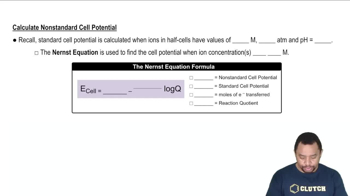
Understand the Nernst equation, which relates the cell voltage to the concentrations of the reactants and products. The equation is: E = E^0 - (RT/nF) \(\ln\) Q, where E is the cell potential, E^0 is the standard cell potential, R is the gas constant, T is the temperature in Kelvin, n is the number of moles of electrons transferred, F is the Faraday constant, and Q is the reaction quotient.
Analyze how the reaction quotient Q changes with the concentration of KOH. Since Q is affected by the concentrations of the reactants and products, a change in KOH concentration will alter Q.
Calculate the new cell voltage using the Nernst equation after substituting the new concentration of KOH. This involves recalculating Q with the new concentration and then using it in the Nernst equation to find the new E.
Explain the relationship between the change in KOH concentration and the cell voltage. A tenfold increase in KOH concentration will either increase or decrease Q, depending on whether KOH is a reactant or a product in the half-reactions, thus affecting the cell voltage accordingly.

비슷한 문제에 대한 검증된 영상 답변:

이 영상 해법은 위 문제에 도움이 된다고 튜터들이 추천한 것입니다.
영상 길이:
5m
도움이 되었나요?

주요 개념

질문에 올바르게 답하기 위해 반드시 이해해야 하는 핵심 개념들은 다음과 같습니다.

Nernst Equation

The Nernst Equation relates the cell potential to the concentrations of the reactants and products in an electrochemical cell. It shows how the voltage of a cell changes with varying concentrations, allowing us to predict the effect of concentration changes on cell voltage. Specifically, it states that the cell potential increases with an increase in the concentration of reactants and decreases with an increase in the concentration of products.
추천 영상:
가이드 코스
01:17
The Nernst Equation

Electrochemical Cell

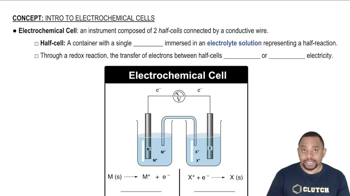
An electrochemical cell consists of two electrodes (anode and cathode) immersed in an electrolyte, where oxidation and reduction reactions occur. The cell voltage is determined by the difference in potential between the two electrodes, which is influenced by the concentration of ions in the electrolyte. In the case of a mercury battery, the concentration of KOH affects the availability of hydroxide ions, which can impact the overall cell reaction and voltage.
추천 영상:
가이드 코스
02:46
Electrochemical Cells

Concentration and Cell Voltage Relationship

The relationship between concentration and cell voltage is crucial in electrochemistry. A tenfold change in the concentration of KOH will significantly affect the concentration of hydroxide ions in the electrolyte, which can shift the equilibrium of the half-reactions. This shift can lead to a measurable change in the cell voltage, as described by the Nernst Equation, highlighting the importance of concentration in determining the efficiency and output of electrochemical cells.
추천 영상:
가이드 코스
03:55
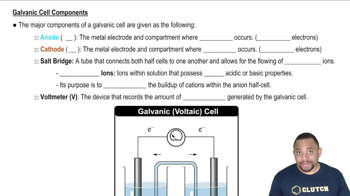
Galvanic Cell Components
관련 실천