Ch.19 - Electrochemistry
McMurry - Chemistry 8th Edition
McMurry8th EditionChemistryISBN: 9781292336145당신이 사용하는 게 아니라요?교과서 변경
19장, 문제 62a

An H2/H+ half-cell (anode) and an Ag+/Ag half cell (cathode) are connected by a wire and a salt bridge. (a) Sketch the cell, indicating the direction of electron and ion flow.

검증된 단계별 안내
1
Start by drawing two separate containers or beakers to represent the half-cells. Label one as the H2/H+ half-cell (anode) and the other as the Ag+/Ag half-cell (cathode).
In the anode half-cell, draw a platinum electrode immersed in a solution containing H+ ions. Above the solution, indicate the presence of H2 gas.
In the cathode half-cell, draw a silver electrode immersed in a solution containing Ag+ ions.
Connect the two electrodes with a wire, and indicate the direction of electron flow from the anode to the cathode.
Draw a salt bridge connecting the two solutions, and indicate the flow of ions: anions moving towards the anode and cations moving towards the cathode.

비슷한 문제에 대한 검증된 영상 답변:

이 영상 해법은 위 문제에 도움이 된다고 튜터들이 추천한 것입니다.
영상 길이:
4m
도움이 되었나요?

주요 개념

질문에 올바르게 답하기 위해 반드시 이해해야 하는 핵심 개념들은 다음과 같습니다.

Electrochemical Cells

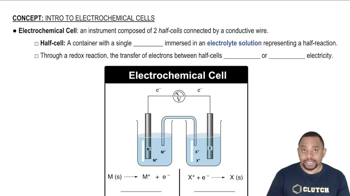
Electrochemical cells consist of two half-cells, where oxidation occurs at the anode and reduction at the cathode. In this setup, the H2/H+ half-cell serves as the anode, where hydrogen gas is oxidized to protons, while the Ag+/Ag half-cell acts as the cathode, where silver ions are reduced to solid silver. Understanding the flow of electrons and ions is crucial for analyzing the cell's operation.
추천 영상:
가이드 코스
02:46
Electrochemical Cells

Electron Flow

In an electrochemical cell, electrons flow from the anode to the cathode through an external circuit. This flow occurs because oxidation at the anode generates electrons, which are then attracted to the cathode, where reduction takes place. Recognizing the direction of electron flow is essential for understanding how the cell generates electrical energy.
추천 영상:
가이드 코스
04:44
Electron Geometry

Salt Bridge Function

A salt bridge is a crucial component of an electrochemical cell that maintains electrical neutrality by allowing the flow of ions between the two half-cells. It typically contains a gel or solution of an inert electrolyte, which helps balance the charge as electrons move through the external circuit. Understanding the role of the salt bridge is important for ensuring the continuous operation of the cell.
추천 영상: