Ch.19 - Electrochemistry
McMurry - Chemistry 8th Edition
McMurry8th EditionChemistryISBN: 9781292336145당신이 사용하는 게 아니라요?교과서 변경
19장, 문제 9

Calculate E° for each of the following reactions, and determine which are spontaneous under standard-state conditions. (b)

검증된 단계별 안내
1
Identify the half-reactions involved in the given chemical equation. Each half-reaction will have its own standard reduction potential (E°).
Look up the standard reduction potentials (E°) for each half-reaction from a standard reduction potential table.
Determine which half-reaction will act as the reduction and which will act as the oxidation. The half-reaction with the higher E° value will be the reduction, and the other will be the oxidation.
Calculate the standard cell potential (E°_cell) using the formula: E°_cell = E°_cathode - E°_anode, where E°_cathode is the reduction potential of the reduction half-reaction and E°_anode is the reduction potential of the oxidation half-reaction.
Determine the spontaneity of the reaction under standard-state conditions. If E°_cell is positive, the reaction is spontaneous; if it is negative, the reaction is non-spontaneous.

주요 개념

질문에 올바르게 답하기 위해 반드시 이해해야 하는 핵심 개념들은 다음과 같습니다.

Standard Electrode Potential (E°)

Standard electrode potential (E°) is a measure of the tendency of a chemical species to be reduced, measured under standard conditions (1 M concentration, 1 atm pressure, and 25°C). It is expressed in volts and is crucial for predicting the direction of redox reactions. A positive E° indicates a spontaneous reaction when coupled with a suitable half-reaction.
추천 영상:
가이드 코스
01:27
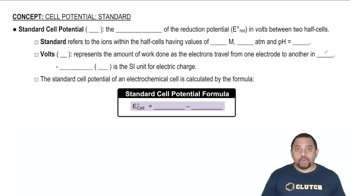
Standard Cell Potential

Gibbs Free Energy (ΔG)

Gibbs free energy (ΔG) is a thermodynamic potential that indicates the spontaneity of a reaction at constant temperature and pressure. The relationship between E° and ΔG is given by the equation ΔG = -nFE°, where n is the number of moles of electrons transferred and F is Faraday's constant. A negative ΔG signifies that a reaction is spontaneous.
추천 영상:
가이드 코스
01:51
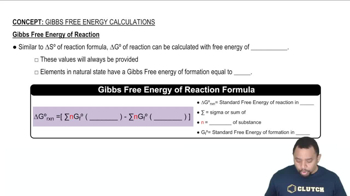
Gibbs Free Energy of Reactions

Nernst Equation

The Nernst equation relates the cell potential (E) of an electrochemical reaction to the standard electrode potential (E°) and the concentrations of the reactants and products. It is expressed as E = E° - (RT/nF)ln(Q), where Q is the reaction quotient. This equation allows for the calculation of cell potential under non-standard conditions, helping to assess spontaneity in various scenarios.
추천 영상:
가이드 코스
01:17
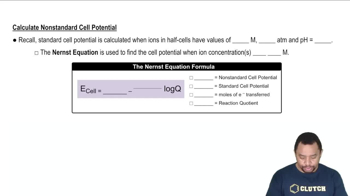
The Nernst Equation