Ch.19 - Electrochemistry
McMurry - Chemistry 8th Edition
McMurry8th EditionChemistryISBN: 9781292336145당신이 사용하는 게 아니라요?교과서 변경
19장, 문제 15

Chlorine can be prepared in the laboratory by the reaction of hydrochloric acid and potassium permanganate. (c) How many liters of Cl₂ at 1.0 atm and 25 °C will result from the reaction of 179 g KMnO₄ with an excess of HCl?

검증된 단계별 안내
1
Step 1: Write the balanced chemical equation for the reaction between potassium permanganate (KMnO₄) and hydrochloric acid (HCl) to produce chlorine gas (Cl₂). The balanced equation is: 2 KMnO₄ + 16 HCl → 2 MnCl₂ + 5 Cl₂ + 2 KCl + 8 H₂O.
Step 2: Calculate the molar mass of KMnO₄. The molar mass is the sum of the atomic masses of all atoms in the formula: K (39.10 g/mol) + Mn (54.94 g/mol) + 4 O (4 x 16.00 g/mol) = 158.04 g/mol.
Step 3: Determine the number of moles of KMnO₄ used in the reaction. Use the formula: moles = mass (g) / molar mass (g/mol). Substitute the given mass of KMnO₄ (179 g) and the molar mass calculated in Step 2.
Step 4: Use stoichiometry to find the moles of Cl₂ produced. According to the balanced equation, 2 moles of KMnO₄ produce 5 moles of Cl₂. Use the mole ratio from the balanced equation to convert moles of KMnO₄ to moles of Cl₂.
Step 5: Use the ideal gas law to calculate the volume of Cl₂ gas produced at 1.0 atm and 25 °C. The ideal gas law is PV = nRT, where P is pressure, V is volume, n is moles, R is the ideal gas constant (0.0821 L·atm/mol·K), and T is temperature in Kelvin. Convert 25 °C to Kelvin and solve for V.

주요 개념

질문에 올바르게 답하기 위해 반드시 이해해야 하는 핵심 개념들은 다음과 같습니다.

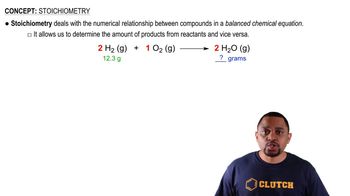
Stoichiometry

Stoichiometry is the calculation of reactants and products in chemical reactions. It involves using balanced chemical equations to determine the proportions of substances consumed and produced. In this case, understanding the stoichiometric coefficients from the reaction between KMnO₄ and HCl is essential to find the amount of Cl₂ generated.
추천 영상:
가이드 코스
01:16
Stoichiometry Concept

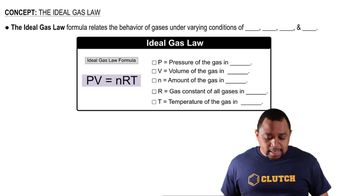
Ideal Gas Law

The Ideal Gas Law relates the pressure, volume, temperature, and number of moles of a gas through the equation PV = nRT. This law is crucial for converting the amount of Cl₂ produced from moles to liters under specified conditions (1.0 atm and 25 °C). Knowing how to manipulate this equation allows for the calculation of gas volumes in chemical reactions.
추천 영상:
가이드 코스
01:15
Ideal Gas Law Formula

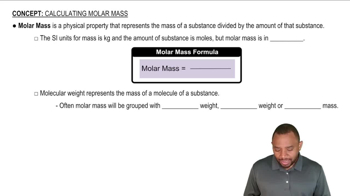
Molar Mass

Molar mass is the mass of one mole of a substance, typically expressed in grams per mole (g/mol). For KMnO₄, calculating its molar mass is necessary to convert the given mass (179 g) into moles. This conversion is a fundamental step in stoichiometric calculations, enabling the determination of how many moles of Cl₂ can be produced from the reaction.
추천 영상:
가이드 코스
02:11
Molar Mass Concept