Ch.19 - Electrochemistry
McMurry - Chemistry 8th Edition
McMurry8th EditionChemistryISBN: 9781292336145당신이 사용하는 게 아니라요?교과서 변경
19장, 문제 42c

Classify each of the following unbalanced half-reactions as either an oxidation or a reduction. (c) Cr(s) → Cr3+ (aq)

검증된 단계별 안내
1
Identify the change in oxidation state for chromium (Cr) in the given half-reaction.
Determine the initial oxidation state of Cr in its elemental form, Cr(s).
Determine the final oxidation state of Cr in the ion form, Cr^{3+} (aq).
Compare the initial and final oxidation states to see if there is an increase or decrease.
Classify the half-reaction: if the oxidation state increases, it is an oxidation; if it decreases, it is a reduction.

비슷한 문제에 대한 검증된 영상 답변:

이 영상 해법은 위 문제에 도움이 된다고 튜터들이 추천한 것입니다.
영상 길이:
1m
도움이 되었나요?

주요 개념

질문에 올바르게 답하기 위해 반드시 이해해야 하는 핵심 개념들은 다음과 같습니다.

Oxidation and Reduction

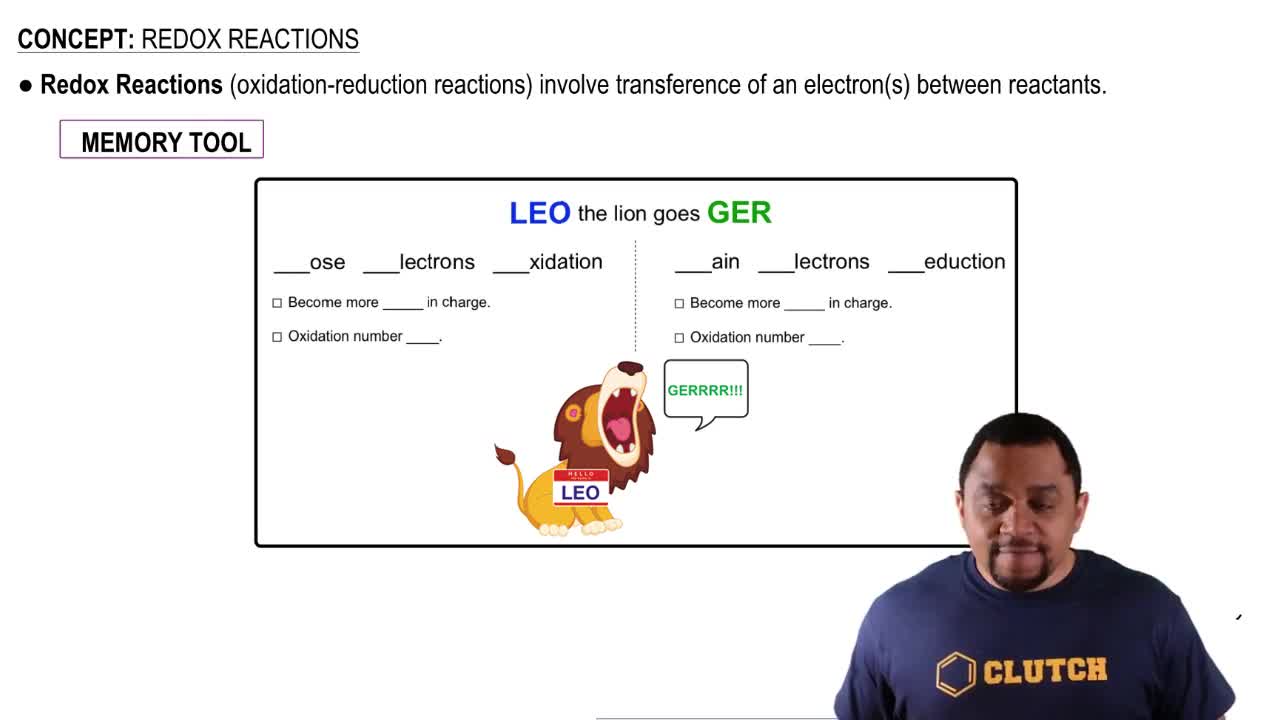
Oxidation and reduction are chemical processes that involve the transfer of electrons between species. Oxidation refers to the loss of electrons, resulting in an increase in oxidation state, while reduction involves the gain of electrons, leading to a decrease in oxidation state. These processes are always coupled; when one species is oxidized, another must be reduced.
추천 영상:
가이드 코스
01:53
Oxidation and Reduction Reactions

Oxidation States

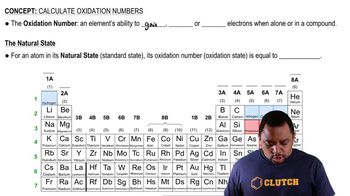
Oxidation states (or oxidation numbers) are a way to keep track of electron transfer in chemical reactions. They indicate the degree of oxidation of an atom in a compound, with higher oxidation states reflecting a greater loss of electrons. In the half-reaction Cr(s) → Cr<sup>3+</sup> (aq), chromium transitions from an oxidation state of 0 in the solid state to +3 in the aqueous ion, indicating oxidation.
추천 영상:
가이드 코스
02:42
Oxidation Numbers

Half-Reactions

Half-reactions are used to represent the oxidation and reduction processes separately in a redox reaction. Each half-reaction shows either the loss of electrons (oxidation) or the gain of electrons (reduction) and can be combined to balance the overall reaction. Identifying half-reactions helps in understanding the electron flow and the changes in oxidation states during the reaction.
추천 영상:
가이드 코스
01:49
First-Order Half-Life
관련 실천
교과서 질문

Classify each of the following unbalanced half-reactions as either an oxidation or a reduction. (b) Pt2+ (aq) → Pt(s)

430
views

교과서 질문

Classify each of the following unbalanced half-reactions as either an oxidation or a reduction. (c) MnO4-(aq) → MnO42-(aq)

412
views
교과서 질문

Classify each of the following unbalanced half-reactions as either an oxidation or a reduction. (b) H2O2(aq) → O2(g)

379
views
교과서 질문

Porous pellets of TiO2 can be reduced to titanium metal at the cathode of an electrochemical cell containing molten CaCl2 as the electrolyte. When the TiO2 is reduced, the O2-ions dis-solve in the CaCl2 and are subsequently oxidized to O2 gas at the anode. This approach may be the basis for a less expensive process than the one currently used for producing titanium.

(c) Write balanced equations for the anode, cathode, and overall cell reactions.

618
views
교과서 질문

Classify each of the following unbalanced half-reactions as either an oxidation or a reduction. (a) O2(g) → OH-(aq)

511
views
교과서 질문

Porous pellets of TiO2 can be reduced to titanium metal at the cathode of an electrochemical cell containing molten CaCl2 as the electrolyte. When the TiO2 is reduced, the O2-ions dis-solve in the CaCl2 and are subsequently oxidized to O2 gas at the anode. This approach may be the basis for a less expensive process than the one currently used for producing titanium.

(a) Label the anode and cathode, and indicate the signs of the electrodes.

365
views